The AIGNE Framework is a functional AI application development framework designed to simplify and accelerate the process of building scalable, agentic AI applications. It combines functional programming concepts, robust artificial intelligence capabilities, and a modular design to provide a structured environment for developers.
This document provides a high-level overview of the AIGNE Framework's architecture, core components, and key features. It also serves as a navigational guide, directing you to the appropriate documentation path based on your technical background and objectives.
Core Architecture#
The framework is architecturally designed around a central orchestrator, known as the AIGNE, which manages the lifecycle and interactions of various specialized components called Agents. Agents are the fundamental units of work, designed to perform specific tasks. They can be composed into teams to handle complex workflows.
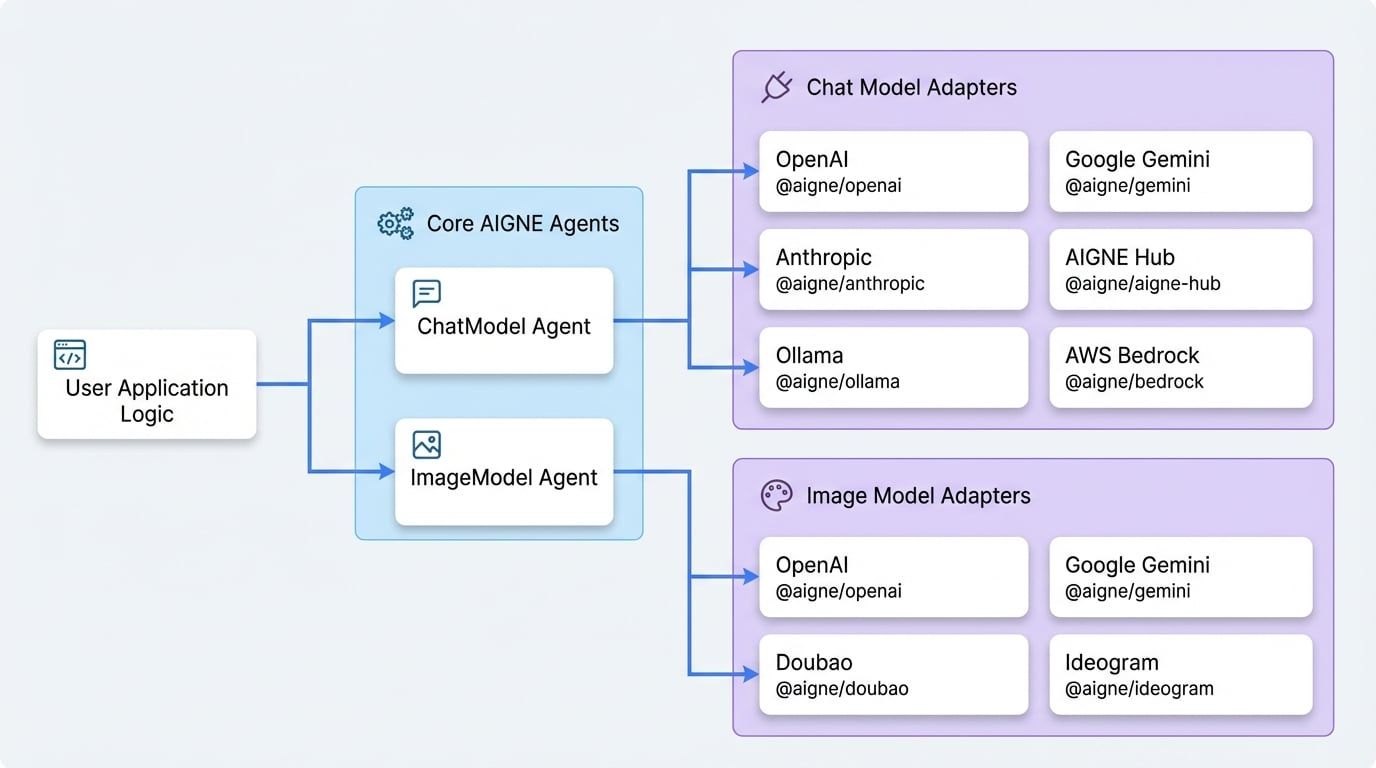
The following diagram illustrates the relationship between these core components:
- AIGNE: The central execution engine responsible for managing the lifecycle of agents, orchestrating their interactions, and handling the overall execution flow. It is instantiated with a configuration that can include models, agents, and skills.
- Agents: The fundamental building blocks of the framework. An agent is an autonomous unit that performs a specific task. The framework provides several specialized agent types, including
AIAgent for interacting with language models, TeamAgent for coordinating multiple agents, and FunctionAgent for executing custom code. - Models: Abstractions that interface with external AI model providers like OpenAI, Anthropic, and Google. These are used by agents to leverage the power of large language models (LLMs) and image generation models.
- Skills: Reusable capabilities, often represented as functions or other agents, that can be attached to an agent to extend its functionality.
Key Features#
The AIGNE Framework is equipped with a comprehensive set of features to support the development of sophisticated AI applications.
Modular Design
A clear modular structure allows developers to organize code effectively, improving development efficiency and simplifying maintenance.
Multiple AI Model Support
Built-in support for a wide range of mainstream AI models, including those from OpenAI, Google, and Anthropic, with an extensible design to support additional models.
Flexible Workflow Patterns
Natively supports various workflow patterns such as sequential, concurrent, and routing to meet complex application requirements.
TypeScript Support
Provides comprehensive TypeScript type definitions, ensuring type safety and enhancing the overall developer experience.
Code Execution
Supports the execution of dynamically generated code within a secure sandbox, enabling powerful automation capabilities.
MCP Protocol Integration
Seamlessly integrates with external systems and services through the Model Context Protocol (MCP).
How to Use These Docs#
To accommodate different needs, this documentation is divided into two primary paths. Please select the path that best aligns with your role and goals.
Summary#
This overview has introduced the AIGNE Framework, its core architecture, and its primary features. The framework is a comprehensive toolset for building modern, agent-based AI applications.
For your next step, we recommend the following:
- Developers: Proceed to the Getting Started guide for a hands-on tutorial.
- Non-technical Users: Begin with What is AIGNE? for a conceptual introduction.