What is AIGNE?
AIGNE (pronounced [ˈei dʒən], like "agent" without the "t") is a functional framework for developing AI applications. It is designed to simplify and accelerate the process of building scalable, modern applications by combining functional programming, modular design, and powerful artificial intelligence capabilities.
The core concept of AIGNE is the use of agents—specialized AI assistants—that can be organized into teams to automate complex, multi-step tasks. Instead of relying on a single, monolithic AI, AIGNE provides the structure to create a digital workforce where different agents collaborate, each handling a specific part of a larger problem.
This document provides a plain-language introduction to the AIGNE Framework, explaining what AI agents are, the problems they solve, and how they work together to automate sophisticated workflows.
What is an AI Agent?#
An AI Agent is a specialized digital assistant designed to perform a specific function. Each agent operates based on a given set of instructions and can be equipped with specific tools to execute its tasks. Unlike a general-purpose chatbot, an AIGNE agent is an expert in a narrow domain.
Consider agents as individual members of a highly efficient project team:
- The Researcher: An agent that can access external information sources to gather data.
- The Writer: An agent that processes raw information and drafts a structured document.
- The Coder: An agent capable of writing and executing code to perform a technical function.
- The Analyst: An agent that can interpret data, identify patterns, and provide insights.
While a single agent is effective for simple, defined tasks, the primary strength of the AIGNE Framework is its ability to orchestrate multiple agents into a cohesive team to achieve a complex objective.
The Problem AIGNE Solves#
A single Large Language Model (LLM) is a powerful tool for tasks like answering questions or generating text. However, its capabilities are limited when faced with processes that require multiple distinct steps, different skill sets, or information from various sources.
For instance, a request such as, "Analyze our latest sales report, compare it to public competitor performance data, and draft a presentation for the marketing team," would be challenging for a standard chatbot. This process involves several discrete stages:
- Data Analysis: Reading and interpreting the internal sales report.
- External Research: Locating and extracting competitor performance data.
- Synthesis: Comparing the two datasets to identify key insights.
- Content Creation: Structuring the findings into a coherent presentation.
AIGNE addresses this by providing a framework to deconstruct such a complex request into manageable sub-tasks. Each sub-task is then assigned to a specialized agent, and the framework manages the flow of information between them, ensuring a complete and accurate final output.
How Agents Work Together to Automate Tasks#
AIGNE orchestrates agents into workflows, which are structured processes for executing tasks. By connecting agents, you can automate processes that would otherwise require significant manual coordination. The framework supports several patterns of collaboration, allowing for flexible and powerful automation.
The following diagram illustrates how the AIGNE Framework breaks down a complex task and manages a team of agents to produce a final result.
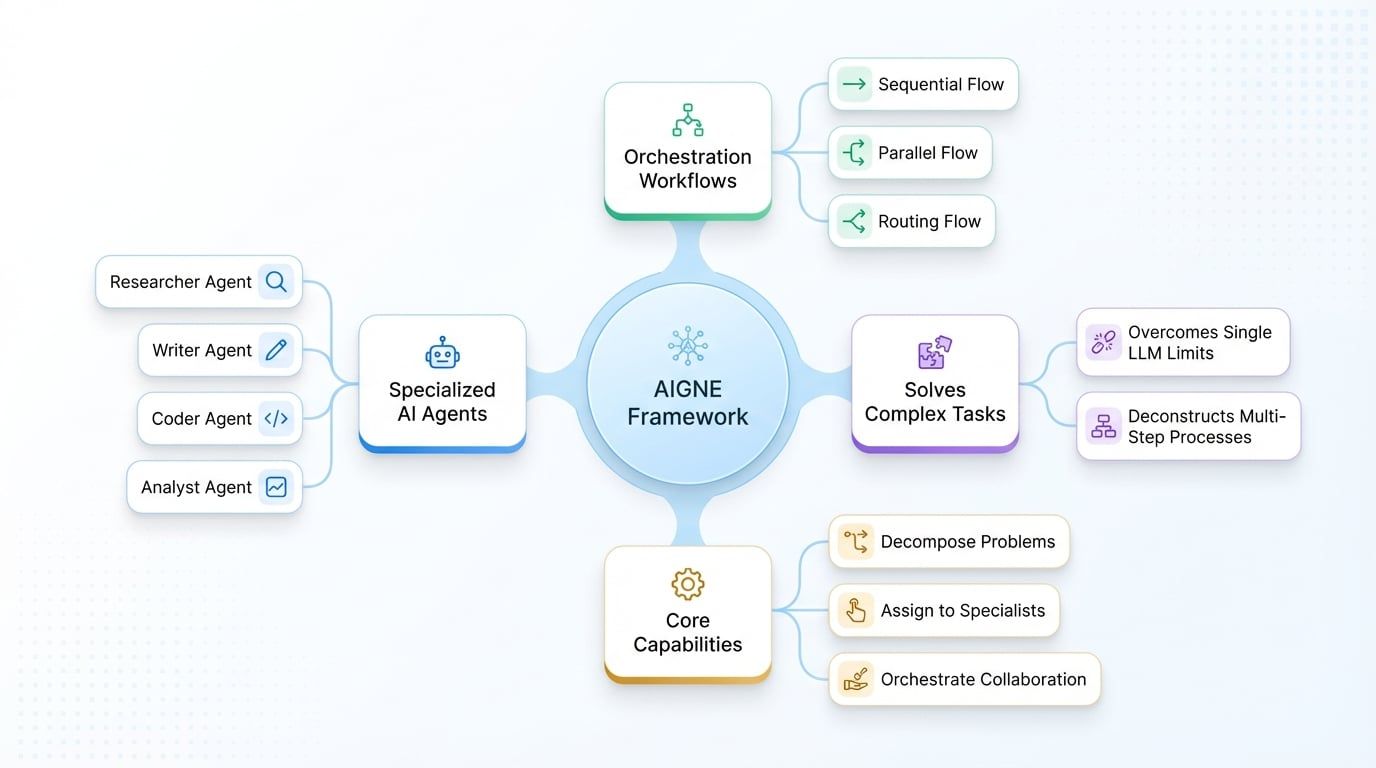
Common workflow patterns include:
- Sequential Workflow (Assembly Line): One agent completes its task and passes the result directly to the next agent. This is suitable for processes with a required order of operations, such as gathering data, summarizing it, and then drafting a report.
- Parallel Workflow (Teamwork): Multiple agents work on different parts of a task simultaneously to improve efficiency. For example, to analyze customer feedback, one agent could process positive reviews while another processes negative reviews at the same time, with the results aggregated at the end.
- Routing Workflow (Manager): A "manager" agent analyzes an incoming request and determines which specialist agent is best equipped to handle it. This pattern is effective for creating intelligent assistants or helpdesks that can address a wide variety of queries.
By combining these workflow patterns, developers can construct sophisticated systems to automate a vast range of digital processes.
Summary#
AIGNE is a framework for building and managing a digital workforce of specialized AI agents. It provides the tools to:
- Decompose complex problems into smaller, well-defined tasks.
- Assign each task to an appropriate AI agent with the right skills.
- Orchestrate the collaboration between agents to achieve a final, coherent goal.
This agent-based approach overcomes the limitations of single AI models, enabling the automation of complex, real-world business processes with greater reliability and precision.
To learn more about the different roles agents can play within the system, proceed to the next section.
- Next: Understanding Agents