Agents
In the AIGNE Framework, the Agent is the fundamental unit of work. It is an abstract class that establishes a standard contract for all specialized agent types. An agent can be conceptualized as a distinct worker capable of executing a specific task, processing information, and interacting with other agents within the system.
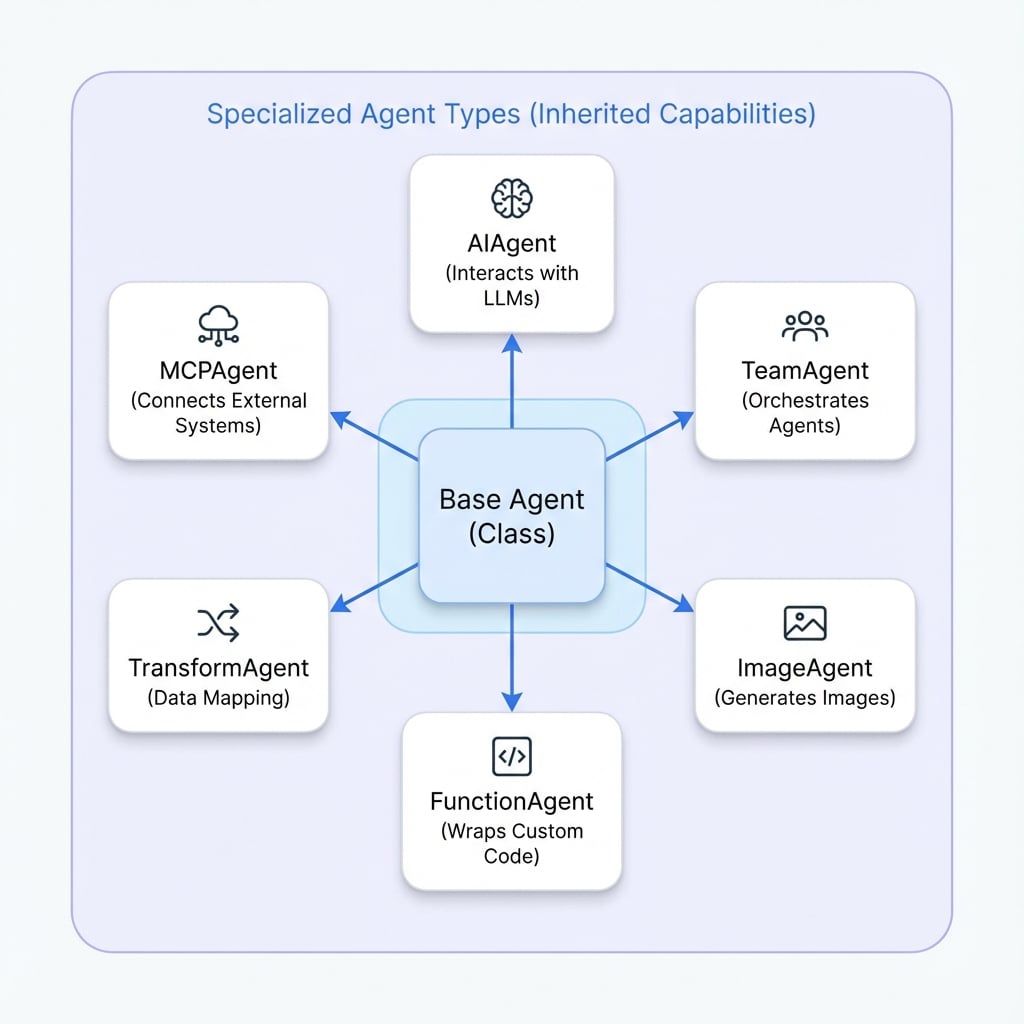
Every specialized agent, whether designed for interacting with an AI model, transforming data, or orchestrating a team of other agents, inherits its core structure and behavior from this base Agent class. This architectural principle ensures consistency and predictability across the framework.
Further reading on specialized agent types can be found in the Agent Types section.
Core Concepts#
The Agent class is designed around several core concepts that define its identity, data contracts, and operational behavior. These are configured via the AgentOptions object during the agent's instantiation.
Key Properties#
The following properties define an agent's configuration:
Property | Type | Description |
|---|---|---|
|
| A unique identifier for the agent, used for logging and referencing. It defaults to the constructor's class name if not specified. |
|
| A human-readable summary of the agent's purpose and capabilities, useful for documentation and debugging. |
|
| A Zod schema defining the structure and validation rules for the agent's input data. This ensures data integrity. |
|
| A Zod schema defining the structure and validation rules for the agent's output data. |
|
| A list of other agents that this agent can invoke to perform delegated sub-tasks, enabling compositional behavior. |
|
| An optional memory unit allowing the agent to persist and recall state across multiple interactions. |
|
| A set of lifecycle hooks (e.g., |
|
| A list of specialized agents that enforce rules, policies, or constraints on the agent's inputs and outputs. |
The process Method#
The process method is the central component of every agent. It is defined as an abstract method in the base Agent class, which mandates that any concrete agent class must provide an implementation. This method contains the core logic that defines what the agent does.
The method receives the validated input message and invocation options, including the execution Context, and is responsible for producing an output.
Agent.ts
export abstract class Agent<I extends Message = any, O extends Message = any> {
  // ... constructor and other properties

  /**
   * Core processing method of the agent, must be implemented in subclasses
   *
   * @param input Input message
   * @param options Options for agent invocation
   * @returns Processing result
   */
  abstract process(input: I, options: AgentInvokeOptions): PromiseOrValue<AgentProcessResult<O>>;

  // ... other methods
}
The return value, AgentProcessResult, can be a direct object, a streaming response, an async generator, or another agent instance for task forwarding.
Agent Lifecycle#
The execution of an agent adheres to a structured lifecycle, which provides clear points for extension via hooks.
- Invocation: An agent's execution is initiated by calling its
invoke()method with an input payload. onStartHook: TheonStarthooks are triggered, providing an opportunity for pre-processing logic, such as logging or input transformation.- Input Validation: The input data is automatically validated against the agent's
inputSchema. If validation fails, the process is aborted. process()Execution: The core logic defined in the agent'sprocess()method is executed.- Output Validation: The result from the
process()method is validated against the agent'soutputSchema. onEndHook: TheonEndhooks are triggered with the final output or any error that occurred. This is the designated point for post-processing, logging results, or implementing custom failure handling.- Return Value: The final, validated output is returned to the original caller.
This systematic lifecycle ensures that data is consistently validated and offers clear, non-invasive extension points for custom logic.
Implementation Example#
To create a functional agent, extend the base Agent class and implement the process method. The following example defines an agent that accepts two numbers and returns their sum.
adder-agent.ts
import { Agent, type AgentInvokeOptions, type Message } from "@aigne/core";
import { z } from "zod";

// 1. Define the input and output schemas using Zod for validation.
const inputSchema = z.object({
  a: z.number(),
  b: z.number(),
});

const outputSchema = z.object({
  sum: z.number(),
});

// 2. Infer TypeScript types from the Zod schemas.
type AddAgentInput = z.infer<typeof inputSchema>;
type AddAgentOutput = z.infer<typeof outputSchema>;

// 3. Create the custom agent class by extending Agent.
export class AddAgent extends Agent<AddAgentInput, AddAgentOutput> {
  constructor() {
    super({
      name: "AddAgent",
      description: "An agent that adds two numbers.",
      inputSchema,
      outputSchema,
See all 10 lines
This example illustrates the standard implementation pattern:
- Define Zod schemas for input and output data structures.
- Extend the
Agentclass with the corresponding input and output types. - Provide the schemas and other metadata to the
super()constructor. - Implement the agent's specific logic within the
processmethod.
Summary#
The Agent class is the foundational abstraction in the AIGNE Framework. It provides a consistent and robust contract for all operational units, ensuring they are identifiable, adhere to clear data schemas, and follow a predictable execution lifecycle. By abstracting this common machinery, the framework allows developers to focus exclusively on implementing the unique logic required for their tasks within the process method.
For details on how agents are executed and managed by the central engine, refer to the AIGNE documentation. To explore the various specialized agent implementations available, see the Agent Types section.