To effectively build applications with the AIGNE Framework, it is essential to first understand its fundamental architectural components. This section provides a high-level overview of the primary building blocks and their interactions. A clear grasp of these concepts will facilitate a more intuitive development process.
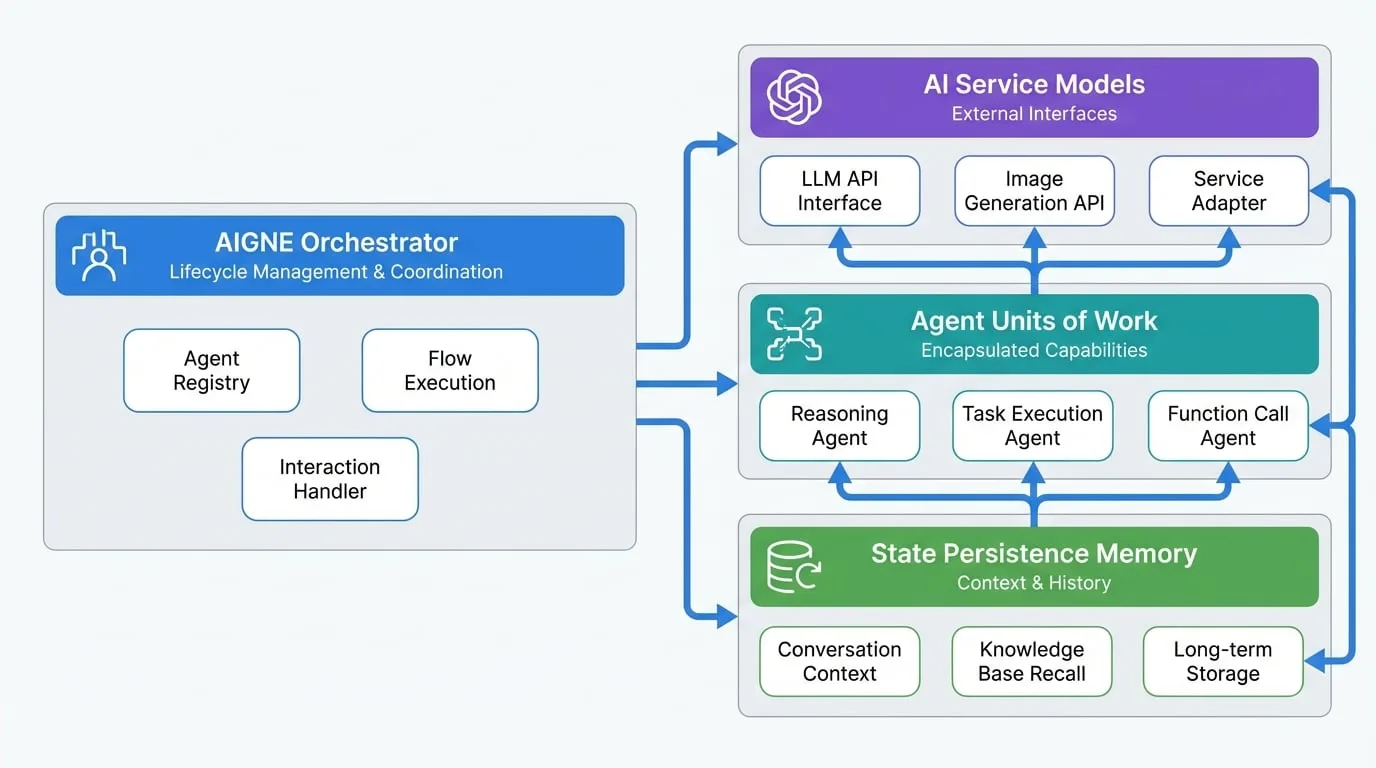
The framework is designed around a few key abstractions that work together to orchestrate complex AI-driven workflows. The main components are the AIGNE orchestrator, the Agent as the basic unit of work, Models for interfacing with AI services, and Memory for state persistence.
The following diagram illustrates the relationship between these core components.
Architectural Building Blocks
The AIGNE Framework is composed of four primary concepts. Understanding each one is crucial for building robust and scalable agent-based applications.
AIGNE
The central orchestrator responsible for managing the lifecycle of agents, coordinating their interactions, and handling the overall execution flow.
Agents
The fundamental unit of work. An Agent is an abstraction that encapsulates a specific capability, from running a simple function to complex reasoning.
Models
Specialized agents that provide a standardized interface to external services, such as Large Language Models (LLMs) or image generation APIs.
Memory
Provides agents with the ability to persist and recall information, enabling stateful conversations and context-aware behavior over time.
Summary
This section has introduced the four foundational pillars of the AIGNE Framework: the AIGNE orchestrator, the Agent, Models, and Memory. Each component plays a distinct and vital role in the architecture.
For a more comprehensive understanding, it is recommended to proceed to the detailed documentation for each concept.
- Next: Dive deeper into the AIGNE orchestrator.