The AIGNE Framework provides a suite of specialized agent types, each designed to perform a specific function. While all agents inherit from the base Agent class, these specialized implementations offer pre-built capabilities for common tasks, from interacting with AI models to orchestrating complex workflows. Understanding these types is key to building robust and efficient applications.
This section provides a high-level overview of the available agent types. For detailed implementation, configuration options, and code examples, please refer to the specific sub-document for each agent.
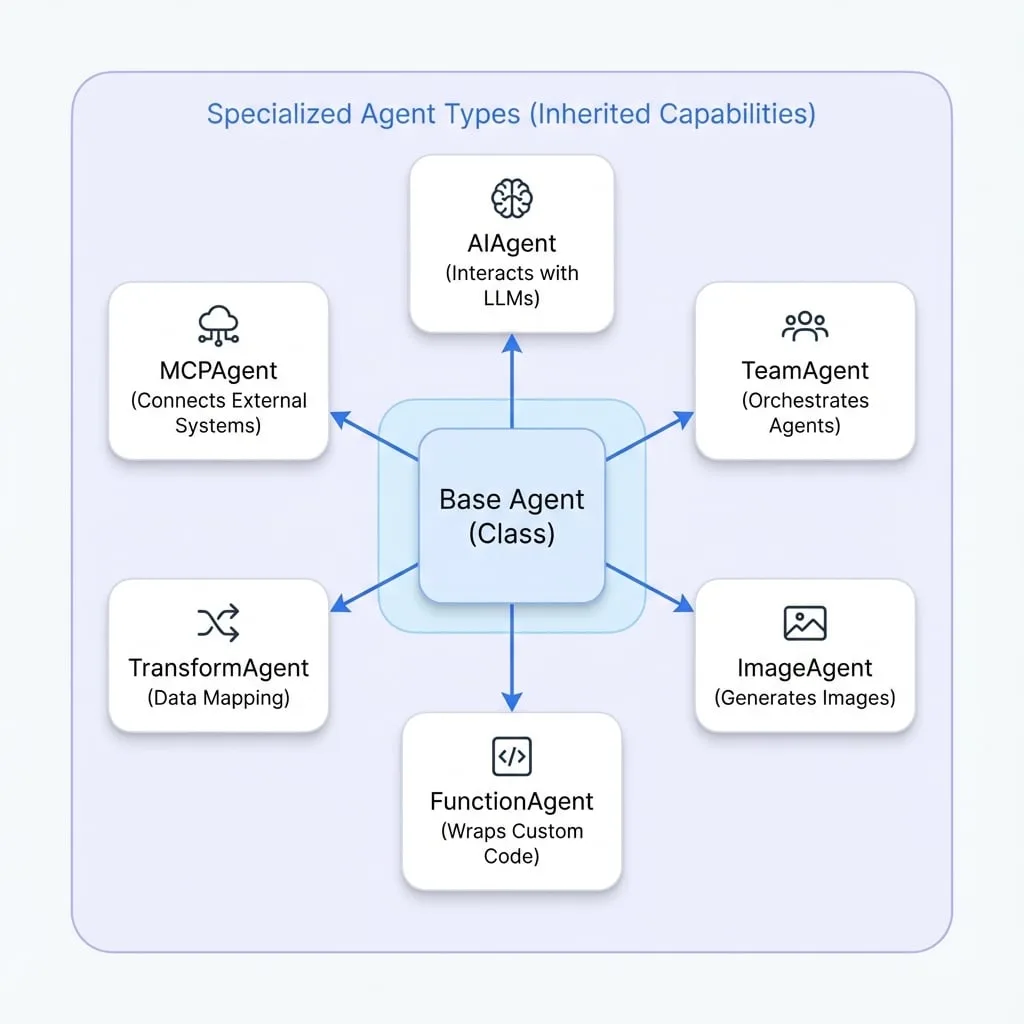
Available Agent Types
The framework includes the following specialized agents, each tailored for a distinct purpose.
AI Agent
The primary agent for interacting with large language models (LLMs). It handles prompt construction, model invocation, and processing of AI-generated responses, including tool usage.
Team Agent
Orchestrates a group of agents to work together. It can manage workflows in sequential or parallel modes, enabling complex, multi-step problem-solving.
Image Agent
A specialized agent for interfacing with image generation models. It takes instructional prompts and generates visual content.
Function Agent
Wraps standard TypeScript or JavaScript functions, allowing you to integrate any custom code or business logic seamlessly into an agentic workflow.
Transform Agent
Performs declarative data transformations using JSONata expressions. It is ideal for mapping, restructuring, and converting data between different formats without writing procedural code.
MCP Agent
Connects to external systems and tools via the Model Context Protocol (MCP). This agent acts as a bridge, allowing your application to leverage external resources and capabilities.
Summary
Choosing the correct agent type for a given task is a fundamental step in designing an effective AIGNE application. Each agent is a specialized tool designed for a specific job. By composing these agents, you can build sophisticated systems capable of handling a wide range of tasks.
For a deeper understanding of each agent's capabilities and configuration, please proceed to the detailed documentation for each type.
- Next: Learn about the AI Agent, the core component for interacting with language models.