The BlockletService is a powerful client that acts as the primary interface for your blocklet to interact with the underlying ABT Node services. It simplifies tasks like user management, session handling, role-based access control (RBAC), and retrieving blocklet metadata by wrapping complex GraphQL queries and HTTP requests into a clean, promise-based JavaScript API.
This service is essential for building secure and feature-rich applications that leverage the full power of the Blocklet platform. Before diving into this service, it's helpful to understand the concepts covered in our Authentication guide.
How It Works
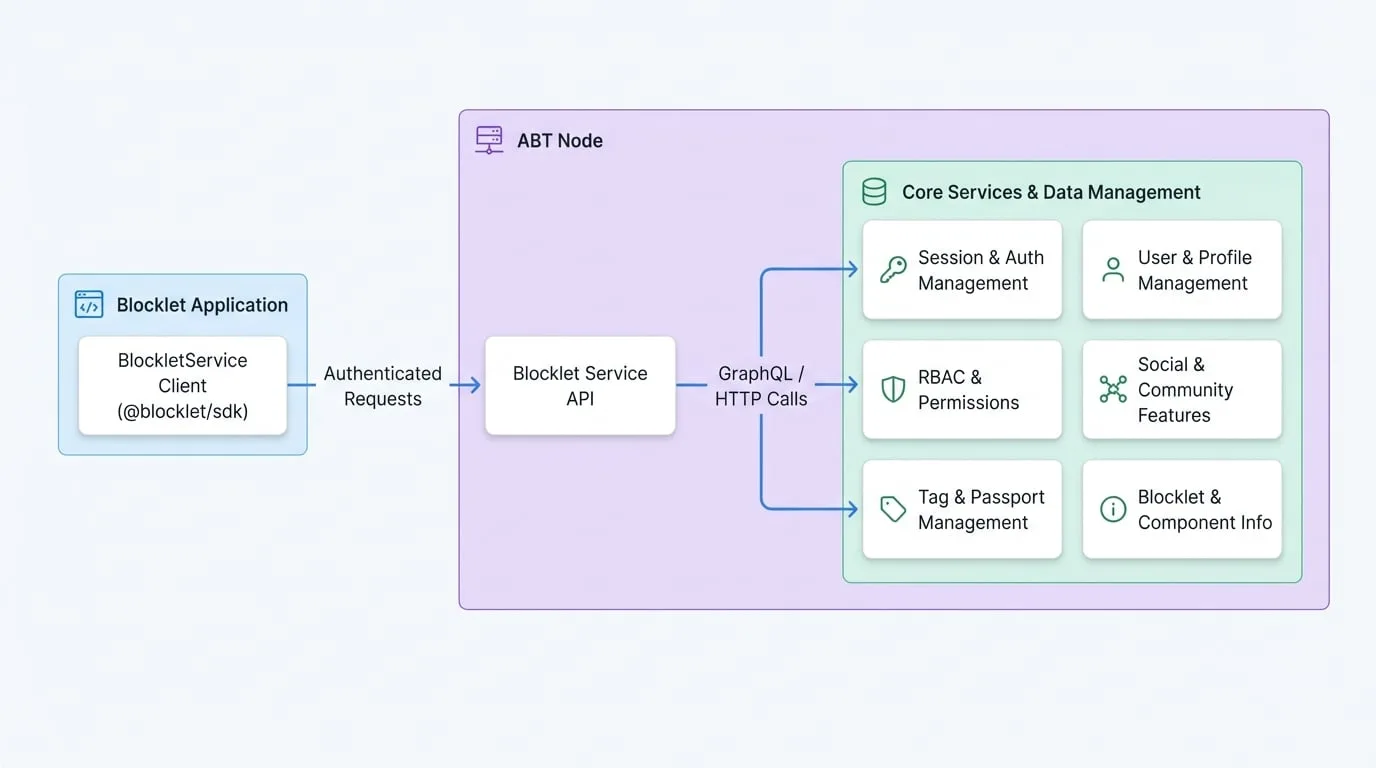
The BlockletService client within your application communicates with the blocklet-service running on the ABT Node. All requests are automatically authenticated using the blocklet's credentials, ensuring secure access to core functionalities.
The following diagram illustrates the communication flow between your blocklet, the Blocklet Service API, and the core services on the ABT Node:
Getting Started
To use the service, simply import and instantiate it. The client will automatically configure itself based on the environment variables provided by the Blocklet Server.
Getting Started
import BlockletService from '@blocklet/sdk/service/blocklet';

const client = new BlockletService();

async function main() {
  const { user } = await client.getOwner();
  console.log('Blocklet owner:', user.fullName);
}

main();
Session Management
login
Authenticates a user and starts a session.
Parameters
- params
object(required) — Login credentials or data.
Returns
- Promise
Promise<object>— An object containing the session and user info.- user
object— The authenticated user's profile. - token
string— The access token for the session. - refreshToken
string— The refresh token to extend the session. - visitorId
string— A unique identifier for the visitor/device.
- user
refreshSession
Refreshes an expired session using a refresh token.
Parameters
- refreshToken
string(required) — The refresh token from a previous session. - visitorId
string— The unique identifier for the visitor/device.
Returns
- Promise
Promise<object>— An object containing the new session and user info.- user
object— The authenticated user's profile. - token
string— The new access token. - refreshToken
string— The new refresh token. - provider
string— The login provider (e.g., 'wallet').
- user
switchProfile
Updates a user's profile information.
Parameters
- did
string(required) — The DID of the user to update. - profile
object(required) — An object with the profile fields to update.- avatar
string— New avatar URL. - email
string— New email address. - fullName
string— New full name.
- avatar
Returns
- ResponseUser
Promise<object>— An object containing the updated user profile.
User Management
getUser
Retrieves a single user's profile by their DID.
Parameters
- did
string(required) — The unique DID of the user to retrieve. - options
object— Optional configuration for the query.- enableConnectedAccount
boolean— If true, includes details about the user's connected accounts (e.g., OAuth providers). - includeTags
boolean— If true, includes any tags associated with the user.
- enableConnectedAccount
Returns
- ResponseUser
Promise<object>— An object containing the user's profile.- user
object— The user profile object.
- user
getUsers
Retrieves a paginated list of users, with support for filtering and sorting.
Parameters
- args
object— An object containing query, sorting, and pagination options.- paging
object— Pagination options.- page
number— The page number to retrieve. - pageSize
number— The number of users per page.
- page
- query
object— Filtering criteria.- role
string— Filter by user role. - approved
boolean— Filter by approval status. - search
string— A search string to match against user fields.
- role
- sort
object— Sorting criteria.- updatedAt
number— Sort by update timestamp.1for ascending,-1for descending. - createdAt
number— Sort by creation timestamp.1for ascending,-1for descending. - lastLoginAt
number— Sort by last login timestamp.1for ascending,-1for descending.
- updatedAt
- paging
Returns
- ResponseUsers
Promise<object>— A paginated list of user objects.- users
TUserInfo[]— An array of user profile objects. - paging
object— Pagination information.- total
number— Total number of users. - pageSize
number— Number of users per page. - page
number— Current page number.
- total
- users
getUsersCount
Gets the total number of users.
Returns
- ResponseGetUsersCount
Promise<object>— An object containing the total user count.- count
number— The total number of users.
- count
getUsersCountPerRole
Gets the count of users for each role.
Returns
- ResponseGetUsersCountPerRole
Promise<object>— An object containing user counts per role.- counts
TKeyValue[]— An array of objects, where each object has akey(role name) andvalue(user count).
- counts
getOwner
Retrieves the profile of the blocklet owner.
Returns
- ResponseUser
Promise<object>— An object containing the owner's user profile.
updateUserApproval
Approves or revokes a user's access to the blocklet.
Parameters
- did
string(required) — The DID of the user to update. - approved
boolean(required) — Set totrueto approve,falseto revoke.
Returns
- ResponseUser
Promise<object>— An object containing the updated user profile.
updateUserTags
Updates the tags associated with a user.
Parameters
- args
object(required)- did
string(required) — The DID of the user. - tags
number[](required) — An array of tag IDs to associate with the user.
- did
Returns
- ResponseUser
Promise<object>— An object containing the updated user profile.
updateUserExtra
Updates the extra metadata for a user.
Parameters
- args
object(required)- did
string(required) — The DID of the user. - remark
string— A remark or note about the user. - extra
string— A JSON string for storing custom data.
- did
Returns
- ResponseUser
Promise<object>— An object containing the updated user profile.
updateUserInfo
Updates a user's general information. Requires a valid user session cookie.
Parameters
- userInfo
object(required) — An object with the user fields to update. Must include the user'sdid. - options
object(required) — Request options including headers.- headers
object(required)- cookie
string(required) — The user's session cookie.
- cookie
- headers
Returns
- ResponseUser
Promise<object>— An object containing the updated user profile.
updateUserAddress
Updates a user's physical address. Requires a valid user session cookie.
Parameters
- args
object(required) — An object with the user's DID and address details.- did
string(required) — The DID of the user. - address
object— The user's address.- country
string— Country - province
string— State/Province - city
string— City - postalCode
string— Postal Code - line1
string— Address line 1 - line2
string— Address line 2
- country
- did
- options
object(required) — Request options including headers.- headers
object(required)- cookie
string(required) — The user's session cookie.
- cookie
- headers
Returns
- ResponseUser
Promise<object>— An object containing the updated user profile.
User Sessions
getUserSessions
Retrieves a list of active sessions for a user.
Parameters
- args
object— An object containing query and pagination options.- paging
object— Pagination options. - query
object— Filtering criteria.- userDid
string— Filter by user DID. - status
string— Filter by session status.
- userDid
- paging
Returns
- ResponseUserSessions
Promise<object>— A paginated list of user sessions.- list
TUserSession[]— An array of session objects. - paging
object— Pagination information.
- list
getUserSessionsCount
Gets the total count of user sessions, with optional filtering.
Parameters
- args
object— An object containing query options.- query
object— Filtering criteria.- userDid
string— Filter by user DID.
- userDid
- query
Returns
- ResponseUserSessionsCount
Promise<object>— An object containing the session count.- count
number— The total number of sessions.
- count
Social & Community
getUserFollowers
Retrieves a list of users who are following a specific user. Requires a valid user session cookie.
Parameters
- args
object(required) — Query options.- userDid
string(required) — The DID of the user whose followers are to be retrieved. - paging
object— Pagination options.
- userDid
- options
object(required) — Request options including headers.- headers
object(required)- cookie
string(required) — The user's session cookie.
- cookie
- headers
Returns
- ResponseUserFollows
Promise<object>— A paginated list of follower users.
getUserFollowing
Retrieves a list of users that a specific user is following. Requires a valid user session cookie.
Parameters
- args
object(required) — Query options.- userDid
string(required) — The DID of the user whose following list is to be retrieved. - paging
object— Pagination options.
- userDid
- options
object(required) — Request options including headers.- headers
object(required)- cookie
string(required) — The user's session cookie.
- cookie
- headers
Returns
- ResponseUserFollows
Promise<object>— A paginated list of users being followed.
getUserFollowStats
Gets the number of followers and following for a user. Requires a valid user session cookie.
Parameters
- args
object(required) — Query options.- userDids
string[](required) — An array of user DIDs.
- userDids
- options
object(required) — Request options including headers.- headers
object(required)- cookie
string(required) — The user's session cookie.
- cookie
- headers
Returns
- ResponseUserRelationCount
Promise<object>— An object with follower and following counts.
checkFollowing
Checks if a user is following one or more other users.
Parameters
- args
object(required)- followerDid
string(required) — The DID of the potential follower. - userDids
string[](required) — An array of user DIDs to check against.
- followerDid
Returns
- ResponseCheckFollowing
Promise<object>— An object where keys are user DIDs and values are booleans indicating the follow status.
followUser
Makes one user follow another.
Parameters
- args
object(required)- followerDid
string(required) — The DID of the user who is following. - userDid
string(required) — The DID of the user to be followed.
- followerDid
Returns
- GeneralResponse
Promise<object>— A general response object indicating success or failure.
unfollowUser
Makes one user unfollow another.
Parameters
- args
object(required)- followerDid
string(required) — The DID of the user who is unfollowing. - userDid
string(required) — The DID of the user to be unfollowed.
- followerDid
Returns
- GeneralResponse
Promise<object>— A general response object indicating success or failure.
getUserInvites
Retrieves a list of users invited by a specific user. Requires a valid user session cookie.
Parameters
- args
object(required) — Query options.- userDid
string(required) — The DID of the inviter. - paging
object— Pagination options.
- userDid
- options
object(required) — Request options including headers.- headers
object(required)- cookie
string(required) — The user's session cookie.
- cookie
- headers
Returns
- ResponseUsers
Promise<object>— A paginated list of invited users.
Tag Management
getTags
Retrieves a list of all available user tags.
Parameters
- args
object- paging
object— Pagination options.
- paging
Returns
- ResponseTags
Promise<object>— A paginated list of tag objects.- tags
TTag[]— An array of tag objects. - paging
object— Pagination information.
- tags
createTag
Creates a new user tag.
Parameters
- args
object(required)- tag
object(required)- title
string(required) — The title of the tag. - description
string— A description for the tag. - color
string— A hex color code for the tag.
- title
- tag
Returns
- ResponseTag
Promise<object>— An object containing the newly created tag.
updateTag
Updates an existing user tag.
Parameters
- args
object(required)- tag
object(required)- id
number(required) — The ID of the tag to update. - title
string— The new title. - description
string— The new description. - color
string— The new color.
- id
- tag
Returns
- ResponseTag
Promise<object>— An object containing the updated tag.
deleteTag
Deletes a user tag.
Parameters
- args
object(required)- tag
object(required)- id
number(required) — The ID of the tag to delete.
- id
- tag
Returns
- ResponseTag
Promise<object>— An object containing the deleted tag.
Role-Based Access Control (RBAC)
getRoles
Retrieves a list of all available roles.
Returns
- ResponseRoles
Promise<object>— An object containing a list of roles.- roles
TRole[]— An array of role objects.
- roles
getRole
Retrieves a single role by its name.
Parameters
- name
string(required) — The unique name of the role.
Returns
- ResponseRole
Promise<object>— An object containing the role details.
createRole
Creates a new role.
Parameters
- args
object(required)- name
string(required) — A unique identifier for the role (e.g.,editor). - title
string(required) — A human-readable title (e.g.,Content Editor). - description
string— A brief description of the role's purpose.
- name
Returns
- ResponseRole
Promise<object>— An object containing the newly created role.
updateRole
Updates an existing role.
Parameters
- name
string(required) — The name of the role to update. - updates
object(required) — An object with the fields to update.- title
string— The new title. - description
string— The new description.
- title
Returns
- ResponseRole
Promise<object>— An object containing the updated role.
deleteRole
Deletes a role.
Parameters
- name
string(required) — The name of the role to delete.
Returns
- GeneralResponse
Promise<object>— A general response object indicating success or failure.
getPermissions
Retrieves a list of all available permissions.
Returns
- ResponsePermissions
Promise<object>— An object containing a list of permissions.- permissions
TPermission[]— An array of permission objects.
- permissions
getPermissionsByRole
Retrieves all permissions granted to a specific role.
Parameters
- role
string(required) — The name of the role.
Returns
- ResponsePermissions
Promise<object>— An object containing the list of permissions for the role.
createPermission
Creates a new permission.
Parameters
- args
object(required)- name
string(required) — A unique name for the permission (e.g.,post:create). - description
string— A description of what the permission allows.
- name
Returns
- ResponsePermission
Promise<object>— An object containing the newly created permission.
updatePermission
Updates an existing permission.
Parameters
- name
string(required) — The name of the permission to update. - updates
object(required)- description
string— The new description for the permission.
- description
Returns
- ResponsePermission
Promise<object>— An object containing the updated permission.
deletePermission
Deletes a permission.
Parameters
- name
string(required) — The name of the permission to delete.
Returns
- GeneralResponse
Promise<object>— A general response object indicating success or failure.
grantPermissionForRole
Assigns a permission to a role.
Parameters
- role
string(required) — The name of the role. - permission
string(required) — The name of the permission to grant.
Returns
- GeneralResponse
Promise<object>— A general response object indicating success or failure.
revokePermissionFromRole
Revokes a permission from a role.
Parameters
- role
string(required) — The name of the role. - permission
string(required) — The name of the permission to revoke.
Returns
- GeneralResponse
Promise<object>— A general response object indicating success or failure.
updatePermissionsForRole
Replaces all existing permissions for a role with a new set.
Parameters
- role
string(required) — The name of the role. - permissions
string[](required) — An array of permission names to set for the role.
Returns
- ResponseRole
Promise<object>— An object containing the updated role.
hasPermission
Checks if a role has a specific permission.
Parameters
- role
string(required) — The name of the role to check. - permission
string(required) — The name of the permission to verify.
Returns
- BooleanResponse
Promise<object>— An object with a booleanresultproperty.- result
boolean—trueif the role has the permission, otherwisefalse.
- result
Passport Management
issuePassportToUser
Issues a new passport to a user, assigning them a role.
Parameters
- args
object(required)- userDid
string(required) — The DID of the user receiving the passport. - role
string(required) — The role to assign with this passport.
- userDid
Returns
- ResponseUser
Promise<object>— An object containing the updated user profile, including the new passport.
enableUserPassport
Enables a previously revoked passport for a user.
Parameters
- args
object(required)- userDid
string(required) — The DID of the user. - passportId
string(required) — The ID of the passport to enable.
- userDid
Returns
- ResponseUser
Promise<object>— An object containing the updated user profile.
revokeUserPassport
Revokes a user's passport.
Parameters
- args
object(required)- userDid
string(required) — The DID of the user. - passportId
string(required) — The ID of the passport to revoke.
- userDid
Returns
- ResponseUser
Promise<object>— An object containing the updated user profile.
removeUserPassport
Permanently removes a user's passport.
Parameters
- args
object(required)- userDid
string(required) — The DID of the user. - passportId
string(required) — The ID of the passport to remove.
- userDid
Returns
- GeneralResponse
Promise<object>— A general response object indicating success or failure.
Blocklet & Component Info
getBlocklet
Retrieves the metadata and state for the current blocklet.
Parameters
- attachRuntimeInfo
boolean(default:false) — Iftrue, includes runtime information like CPU and memory usage. - useCache
boolean(default:true) — Iffalse, bypasses the cache to fetch the latest data.
Returns
- ResponseBlocklet
Promise<object>— An object containing the blocklet's state and metadata.
getComponent
Retrieves the state of a specific component within the current blocklet by its DID.
Parameters
- did
string(required) — The DID of the component to retrieve.
Returns
- ComponentState
Promise<object>— An object containing the component's state and metadata.
getTrustedDomains
Retrieves a list of trusted domains for federated login.
Returns
- string[]
Promise<string[]>— An array of trusted domain URLs.
getVault
Retrieves and verifies the blocklet's vault information.
Returns
- vault
Promise<string>— The vault string if verification is successful.
clearCache
Clears cached data on the node based on a pattern.
Parameters
- args
object- pattern
string— A pattern to match cache keys for removal.
- pattern
Returns
- ResponseClearCache
Promise<object>— An object containing a list of removed cache keys.- removed
string[]— An array of keys that were removed from the cache.
- removed
Access Key Management
createAccessKey
Creates a new access key for programmatic access.
Parameters
- params
object(required)- remark
string— A description for the access key. - passport
string— The role/passport to associate with the key. Defaults to 'guest'.
- remark
Returns
- ResponseCreateAccessKey
Promise<object>— An object containing the newly created access key and secret.
getAccessKey
Retrieves details for a single access key.
Parameters
- params
object(required)- accessKeyId
string(required) — The ID of the access key to retrieve.
- accessKeyId
Returns
- ResponseAccessKey
Promise<object>— An object containing the access key details.
getAccessKeys
Retrieves a list of access keys.
Parameters
- params
object- paging
object— Pagination options.
- paging
Returns
- ResponseAccessKeys
Promise<object>— A paginated list of access key objects.
verifyAccessKey
Verifies if an access key is valid.
Parameters
- params
object(required)- accessKeyId
string(required) — The ID of the access key to verify.
- accessKeyId
Returns
- ResponseAccessKey
Promise<object>— An object containing the access key details if valid.
After mastering the BlockletService, you might want to explore how to send messages to your users. Head over to the Notification Service guide to learn more.