Auto-Topup Components
The auto-topup feature ensures uninterrupted service by automatically recharging a user's credit balance when it falls below a specified threshold. This is managed through two primary components: AutoTopup, which displays the current configuration, and AutoTopupModal, which provides the interface for setting it up.
Auto-Topup Workflow#
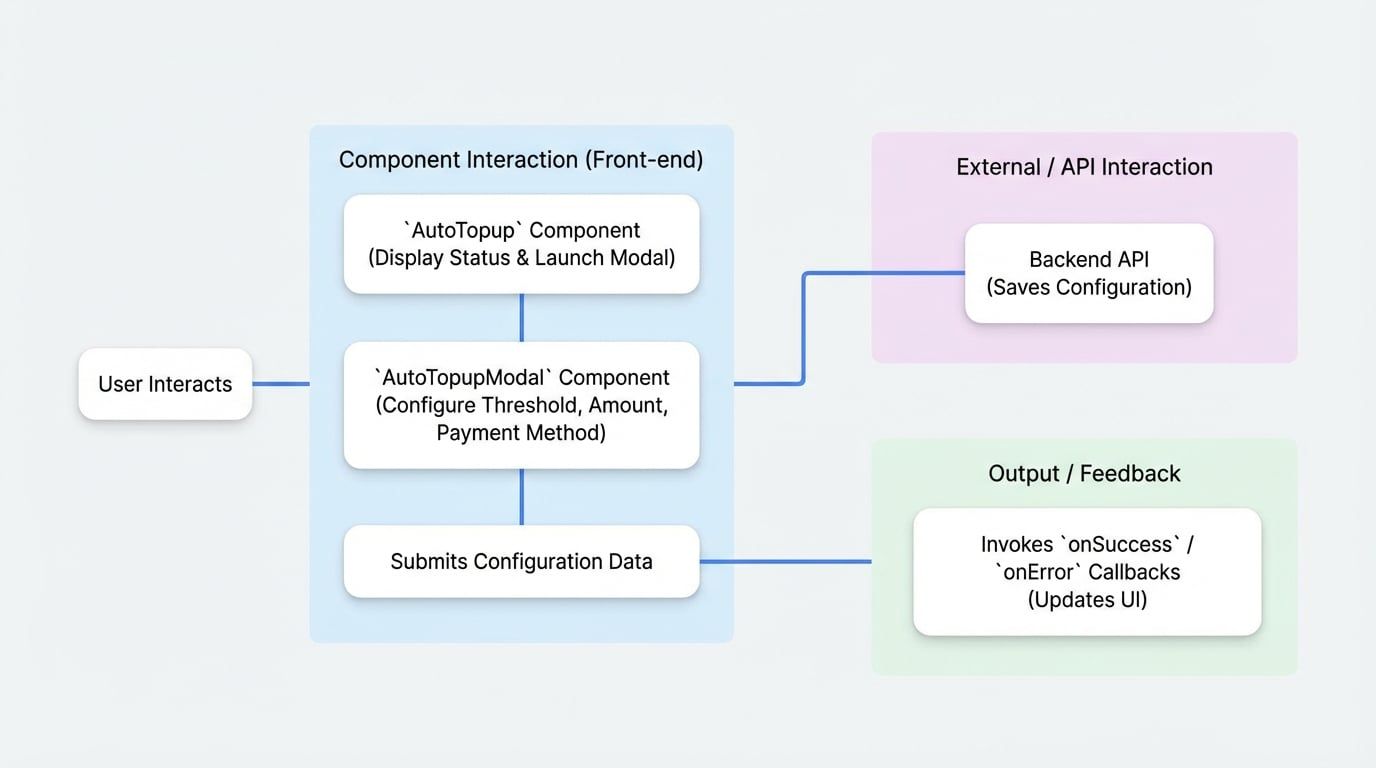
The diagram below illustrates the typical user flow for configuring the auto-topup feature. The user interacts with the AutoTopup display component, which launches the AutoTopupModal for making changes. The modal then communicates with the backend API to save the configuration.
AutoTopup#
The AutoTopup component is a display card that shows the current auto-recharge status for a specific currency and provides an entry point for configuration. It supports multiple rendering modes for flexibility.
Props#
Prop | Type | Description |
|---|---|---|
|
| Required. The ID of the credit currency to manage. |
|
| Optional. Callback function triggered when the configuration is successfully updated. |
|
| Optional. The rendering mode. Defaults to |
|
| Optional. Custom MUI styles to apply to the component. |
|
| Optional. A render prop function used only when |
Usage#
Simple Mode#
This is the most common use case, providing a compact display that users can expand for more details.
CreditManagement.tsx
import { PaymentProvider, AutoTopup } from '@blocklet/payment-react';

function CreditManagement({ session, currencyId }) {
  const handleConfigChange = (config) => {
    console.log('Auto-topup config updated:', config);
    // You might want to refresh the user's balance here
  };

  return (
    <PaymentProvider session={session}>
      <AutoTopup
        currencyId={currencyId}
        mode="simple"
        onConfigChange={handleConfigChange}
        sx={{ mt: 2 }}
      />
    </PaymentProvider>
  );
}
Custom Mode#
For full control over the UI, use custom mode with a render prop. This allows you to integrate the auto-topup status and configuration trigger into your existing layout seamlessly.
CustomAutoTopupDisplay.tsx
import { PaymentProvider, AutoTopup } from '@blocklet/payment-react';
import { Button, Card, CardContent, Typography } from '@mui/material';

function CustomAutoTopupDisplay({ session, currencyId }) {
  return (
    <PaymentProvider session={session}>
      <AutoTopup currencyId={currencyId} mode="custom">
        {(openModal, config, paymentData, loading) => {
          if (loading) return <div>Loading configuration...</div>;

          return (
            <Card variant="outlined">
              <CardContent>
                <Typography variant="h6">Smart Auto-Recharge</Typography>
                {config?.enabled ? (
                  <Typography color="success.main">
                    Status: Active
                  </Typography>
                ) : (
                  <Typography color="text.secondary">
                    Status: Inactive
                  </Typography>
                )}
                <Button onClick={openModal} variant="contained" sx={{ mt: 2 }}>
                  {config?.enabled ? 'Modify Settings' : 'Setup Now'}
See all 9 lines
AutoTopupModal#
The AutoTopupModal is a dialog component that allows users to enable, disable, and configure all aspects of the auto-topup feature, including the trigger threshold, purchase amount, and payment method.
Props#
Prop | Type | Description |
|---|---|---|
|
| Required. Controls whether the modal is visible. |
|
| Required. Callback function to close the modal. |
|
| Required. The ID of the credit currency being configured. |
|
| Optional. The customer's DID. Defaults to the user from the |
|
| Optional. Callback triggered after the configuration is successfully saved. |
|
| Optional. Callback triggered if an error occurs during submission. |
|
| Optional. If |
Usage#
Here is a complete example of how to manage the AutoTopupModal's state and handle its callbacks.
AutoRechargeSettings.tsx
import { PaymentProvider, AutoTopupModal } from '@blocklet/payment-react';
import { useState } from 'react';
import { Button } from '@mui/material';

function AutoRechargeSettings({ session, currencyId }) {
  const [isModalOpen, setModalOpen] = useState(false);

  const handleSuccess = (config) => {
    console.log('Configuration saved successfully:', config);
    setModalOpen(false);
    // Optionally, show a success toast or refresh data
  };

  const handleError = (error) => {
    console.error('Failed to save configuration:', error);
    // Optionally, show an error message to the user
  };

  return (
    <PaymentProvider session={session}>
      <Button variant="contained" onClick={() => setModalOpen(true)}>
        Configure Auto-Recharge
      </Button>

      <AutoTopupModal
See all 10 lines
This setup provides a robust way to manage auto-recharge functionality, giving users control while ensuring a smooth experience for maintaining their service credits.