For users: what it means to own a trading terminal
“I want to exchange an asset. I do not want to develop a DEX or run an exchange business.” That is a reasonable starting point for personal market software. A user needs a usable application and clear limits on who can act for them.
The proposed route is for developers to package capabilities as Blocklets that users deploy in their own ARC environment and connect to personal space and a wallet. Using software does not require becoming its author. The complete workflow still needs to be built. The useful question now is what users should own and control when they run that software.
Why not just use an exchange?
For many people, using an exchange is a perfectly good choice. If they trade occasionally and an existing service offers acceptable convenience, costs and risks, maintaining another application may bring little benefit. Personal market software has to earn the extra effort it asks of its owner.
Consider a frequent property investor who buys and sells homes and manages a portfolio of rentals. They might decide that obtaining the relevant local real-estate agent license and learning to research and negotiate deals themselves is worth the effort. Someone buying a home once may see little reason to do that. Someone who trades regularly and has developed their own judgment may value having those capabilities directly.
The investor does not necessarily want to open a brokerage serving the public. They may simply want more direct participation and choice in their own transactions. A personal trading terminal can serve the same purpose. It need not be a publicly accessible website or an exchange with a different logo. It can retain my preferences, compare opportunities and help me decide when to use professional services.
AI takes the analogy a step further: I could have an agent working under my rules without personally watching every quote. Waiting time, order splitting and the trade-offs between fees and privacy can remain in my ArcSpace. My agent could still use an exchange, an AMM, a market maker or a professional broker. What I own is the tool and the rules for comparing those services.
The analogy concerns capabilities and representation, not equivalent legal qualifications. Running software does not confer a brokerage license or remove obligations that may arise from serving others. Nor does it guarantee a better trade. The product has to answer a practical question: if deployment and upkeep are simple enough, authorization is clear and risks can be controlled, will users accept a little overhead for their own rules, continuous records and replaceable market access? If every trade requires troubleshooting a server, that case falls apart.
A phone can sleep without taking an intent offline
A wallet is a good place for keys and payment approval. It is not necessarily a good place for continuous counterparty communication. Other people may look for a trade while the user sleeps, loses connectivity or closes an application. Early P2P clients put these responsibilities on a personal computer, making its availability part of the user's work.
In the proposed separation, ArcSpace can retain intents, preferences and records while a Blocklet on ARC handles communication. Availability still depends on the deployment: a home device, a personal server and a hosting provider carry different maintenance obligations. Receiving a quote should not require handing over a wallet's master key.
The agent acts as my inquiry assistant, receiving messages under my rules, comparing conditions and recording relevant offers. It represents me rather than presenting an exchange's recommendation algorithm through a chat window.
Decide what it may do before asking it to trade
Configuration should focus on consequential decisions: eligible assets and chains, spending limits, acceptable waiting time, trusted credential issuers and actions requiring fresh approval. A sensible initial mode only reads quotes and makes proposals, with the owner confirming every spending authorization.
Ownership also means understanding communication. Does the application query one mandatory backend or several selectable sources? Do negotiations stay in personal storage or go to a model service? Can I recover my preferences and receipts after switching models or ending a subscription? Deployment in a personal environment does not answer these questions on its own. The application should.
A DID is a verifiable identifier that helps establish who sent a quote and who authorized an agent. A counterparty may require an accepted issuer's credential, such as completion of a particular identity check. Revealing only necessary information depends on the credential formats and verification mechanisms both parties support. A DID alone does not establish trustworthiness.
Follow one OTC exchange
Suppose Alice selects assets to exchange. Her Blocklet publishes a limited summary while keeping her reservation price and full holdings private. Bob, Carol and a market maker discover it and respond. Alice's agent also considers available AMMs and other execution sources. OTC means a negotiated, over-the-counter trade; it need not involve meeting in person or excluding professional intermediaries.
The interface should show comparable outcomes: what leaves my wallet, what arrives, total fees, expiry and required disclosures. Bob may fill the whole amount; Carol may cover only part; a market maker may offer more predictable completion. The agent explains those trade-offs, and the user decides which matter.
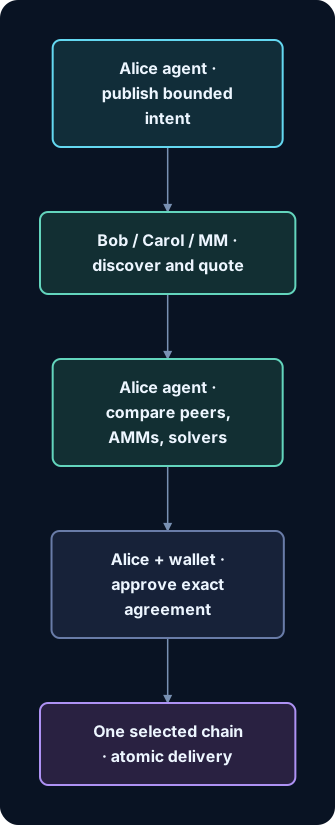
After approval, the wallet presents final assets and amounts, both parties authorize, and the selected chain executes the exchange. For suitable assets on one chain, atomic delivery avoids Alice having to send first and hope a stranger reciprocates. The earlier inquiry and negotiation need not all enter a public transaction queue.
If wallet terms differ from the agreement, the user must not sign. A balance proof reflects a moment in time; execution must still check availability. A signed quote is not a guarantee of a successful fill. After a lost connection, the application should restore the session and reconcile settlement rather than hide uncertainty behind a spinner. The OTC analysis develops splitting, failure and recovery in more detail.
Fiat and physical goods require different assurances. Bank payments may involve reversal or verification, and a chain cannot inspect a parcel. Regulated service providers, escrow, dispute resolution and legal remedies may remain necessary. The guarantee for same-chain digital assets cannot be transferred to those situations by changing the interface.
A personal terminal is not automatically an exchange business
Comparing offers and managing authorization for oneself differs from taking custody, matching or executing for the public, or regularly providing exchange services. Opening a personal tool as a service may change its operator's responsibilities. A public website is not required for an activity to constitute a business. The legal essay examines conduct rather than product names.
Leaving should be ordinary: withdraw public intents, stop new inquiries, review unfinished sessions, revoke remaining authority where the settlement mechanism permits it, and export records. Merely shutting down a Blocklet may not cancel signed executable agreements or existing allowances. The software needs to make residual authority visible.
“Everyone can own a DEX” need not mean everyone operates a miniature exchange company. A more useful meaning is that I can run software made by developers, retain personal state and rules, let my agent find opportunities and keep authorization in my wallet. Persistent infrastructure and AI may lower costs that ordinary users previously struggled to bear. The finished experience will have to demonstrate that possibility.