AFS Is Not Git, and It Does Not Put Meaning in a Tree
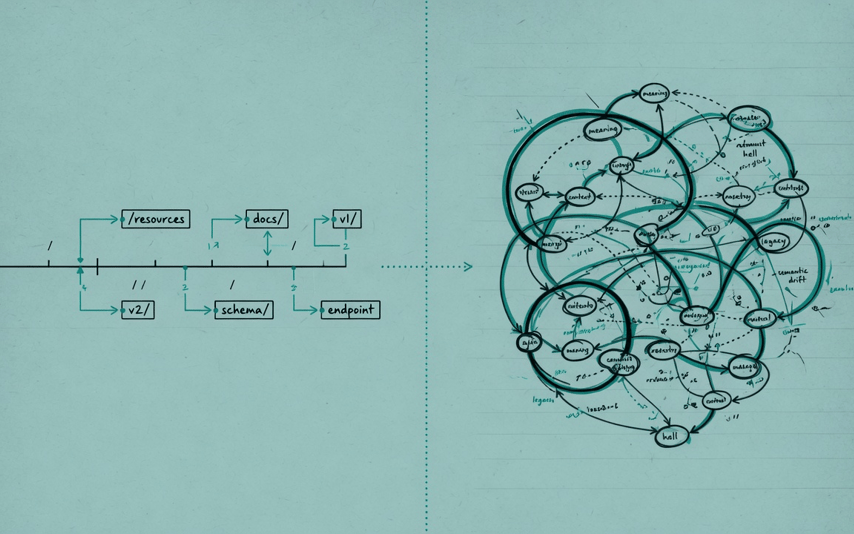
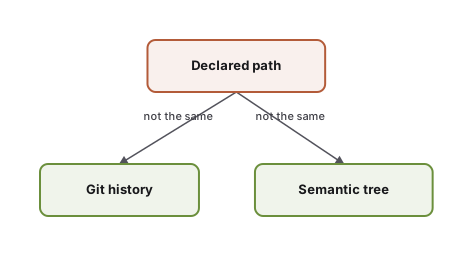
A path places an operation; it does not encode meaning like a knowledge graph.
Whenever I use a file-like abstraction to talk about context, two reasonable questions come up. Semantic relationships are not always hierarchical, so why use paths? And is this just Git?
Both questions expose the same confusion. A file-like interface is not the whole system, a path is not meaning itself, and version history is not every relationship between resources. I want to separate those layers.
Git records history. Paths give operations a place to land.
Someone asked the second question directly.
I answered it in three words:
“Git is VCS.”
Git is good at versions, branches, and merges. It answers how history evolves. That is an important capability, but it does not automatically say which resources an agent operation faces now, which boundary it occupies, or what it may do.
The job of a path is more modest. It lets a read, write, or inspection land in a declared resource view. A declared view might let a task see the project brief but not another set of material. It might let the task read a file without changing it. Permissions themselves still need an explicit policy; a file-like abstraction gives those operational boundaries a clear expression.
This is not a dismissal of Git, nor is it a claim that paths carry no meaning. They do different work. Git gives history a reliable form; a path gives an operation a clear place to land. Treating either one as a universal abstraction makes both less precise.
A path cannot define knowledge
The first question gets an important premise right.
My answer was:
“You're absolutely right that semantic memory is not hierarchical.”
Semantic relationships ask another kind of question: why two pieces of material belong together, how one piece of evidence supports a judgment, or how one record changes the meaning of another. Slashes do not infer those relationships. Semantic retrieval, knowledge graphs, and embeddings all approach the question of why material is related, each with its own models and capabilities.
I do not expect a directory tree to make those judgments for us. A file-like surface gives those capabilities a place to land and a boundary they can respect. It does not claim to have supplied the answer.
A local feel does not mean default sharing
yenkel raised a related concern: a local feel does not erase the relationship between different agents and different environments.
“Feels local” should not mean that everything is visible by default. Nor should it mean that every agent is automatically isolated from every other agent. Who can see what, and who may do what, should be expressed explicitly rather than left to implicit magic.
That is why I still think a file-like abstraction matters. It does not create semantics, and it does not settle every question of sharing or isolation. It gives those questions an operational surface where they can be discussed and acted on.
Further reading
本頁涉及
術語
-
AFS
AFS(Agentic File System)把與任務有關的檔案、服務和正在進行的工作組織成可檢視的資源檢視。它不是把一整台機器或一堆 API 交給 agent,而是給任務一塊有名字、有邊界的工作範圍。