Beyond Virtual Folders: How ArcSpace Uses AI to Automatically Weave Multi-File Threads Across Enterprise and Personal Scenarios

In Part 1 of this series, we showed how ArcSpace projects zero-copy "virtual folders" so you can view 132 GB of files by project, by year, or by media type without duplicating a single byte. Yet as soon as you confront the thousands of PDFs, scanned contracts, emails, invoices, and policies accumulated over years of running a company or managing a household, a deeper challenge emerges:
Grouping files into virtual folders is only the beginning. Real-world company operations and personal lives do not happen in isolated buckets, they unfold as interconnected threads of cause, effect, and obligation across dozens of related files.
Consider two everyday scenarios:
- Inside a Company: From the founders' earliest emails and the
Articles of Incorporation, to each financing round's Term Sheet, Board resolutions, and closing signature pages; from patent invention disclosures, USPTO Office Actions, and responses to multi-year maintenance fees; and from each employee'sOffer Letterand signedNDA / PIIAtoI-9 / E-Verifyconfirmations andW-8BENtax forms. Today, these documents are uploaded four or five separate times across email, HR SaaS (Gusto / Rippling), equity platforms (Carta), and legal data rooms, yet no system connects them into a continuous operational thread to tell you what is missing or expiring. - In Personal and Family Life: Ten years of annual physical lab reports, specialist imaging, prescriptions, hospital bills, and insurance Explanation of Benefits (
EOB) statements, or your household's Auto, Homeowners, and Personal Umbrella insurance policies, are not standalone files. Together, they form a continuous medical history and an interlocking financial safety net.
Why have traditional file systems failed to support these scenarios? Technically, physical directories are constrained by a rigid single-root tree structure (forcing you to pick one parent folder per file), while flat tags lose all temporal and causal order once you pass a few thousand files. What users actually need is not another manual filing scheme, but AI that automatically reads, discovers, and weaves the underlying threads and relationships across multiple files, unlocking practical enterprise and personal workflows on top of those threads.
And crucially, this automated AI thread discovery must happen without compromising privacy: no responsible company or family wants to upload unannounced board resolutions, patent drafts, tax returns, or medical records to an external public AI endpoint.
In ArcSpace, we combine a Local-First 3-Tier AI Pipeline, Automated Multi-Thread Relationship Discovery, and a Proactive Enterprise & Personal Landmine Radar to turn static files into living, protective institutional and personal memory.
1. Zero-Pollution CID Sidecar and the Local-First 3-Tier AI Pipeline: Discovering Deep File Relationships Without Leaking a Single Fact to the Cloud
For AI to automatically weave threads across thousands of files, it first needs to understand what each document actually means: who the parties are, what event or agreement it records, what dates and dollar amounts apply, and which prior documents it references.
Many "smart file organizers" start by renaming your folders, moving your physical files around, or littering your directories with hidden .thumb and .meta clutter. ArcSpace's first engineering rule is Zero Physical Folder Pollution: your mounted local directories, external drives, and NAS shares remain 100% untouched at the byte level.
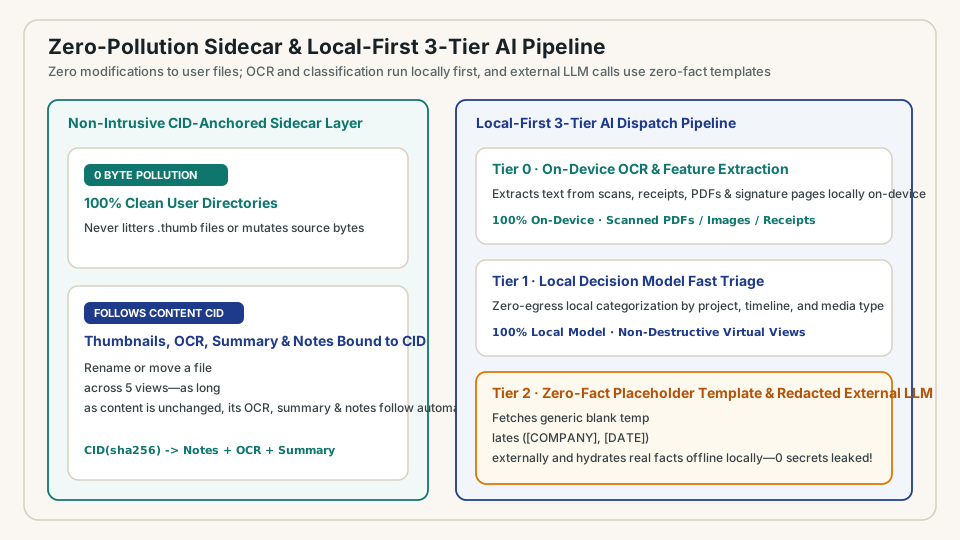
All thumbnails, full-text OCR indexes, AI-extracted entity relationships (people, companies, amounts, effective dates, and cross-document references), and your personal notes are stored in an encrypted Sidecar Ledger, anchored directly to each file's cryptographic content identifier (CID). Anchoring intelligence to the CID means that even if you rename a contract in Finder, move it to another folder, or reference it across five different threads, its AI-discovered relationships and notes follow the content automatically without ever breaking a link.
To extract cross-file threads automatically without compromising privacy, ArcSpace processes files through a strict Local-First 3-Tier AI Pipeline:
- Tier 0 On-Device Extraction and Offline OCR (Zero Bytes Egress): Hardware-accelerated local workers parse PDFs, run offline OCR on scanned contracts and photographed receipts, extract EXIF metadata, and compute cryptographic
CIDfingerprints directly on your machine. - Tier 1 Local Lightweight Decision Model (Zero-Leakage Thread Linking): A fast on-device model evaluates filenames, directory context, and local OCR text to classify documents (distinguishing invoices, employment agreements, lab reports, and insurance policies), extract entities and timestamps, and link related files into multi-branch threads with zero network egress.
- Tier 2 Zero-Fact Placeholder Templates and Redacted External Collaboration: When a complex legal or governance task benefits from a frontier external LLM, ArcSpace never sends raw document text containing real names, dollar amounts, dates, or corporate facts to external APIs. Instead, the system requests a generic structural template populated only with abstract placeholders (
[COMPANY_NAME],[EFFECTIVE_DATE],[SHARES_GRANTED]), and then hydrates those placeholders offline on your local device using the encrypted sidecar ledger. External LLM logs never see a single confidential fact or corporate remediation trail.
2. Beyond Virtual Folders: AI-Driven Multi-Thread Discovery Across Enterprise and Personal Scenarios
While a virtual folder groups similar files into a flat bucket, ArcSpace's Automated Multi-Thread Intelligence goes a step further: it automatically connects files of different types, from different years and different sources, into causal, branching timelines that mirror how your company and life actually work.
Under the hood, every file exists only once on physical storage, while the AI engine weaves zero-copy pointers into Multi-Forking Directed Acyclic Thread Graphs (Thread DAGs) in the control plane. Domain-specific schemas and workflows (corporate governance rules, tax calendars, insurance comparison logic) run as modular upper-layer skills on top of this graph.
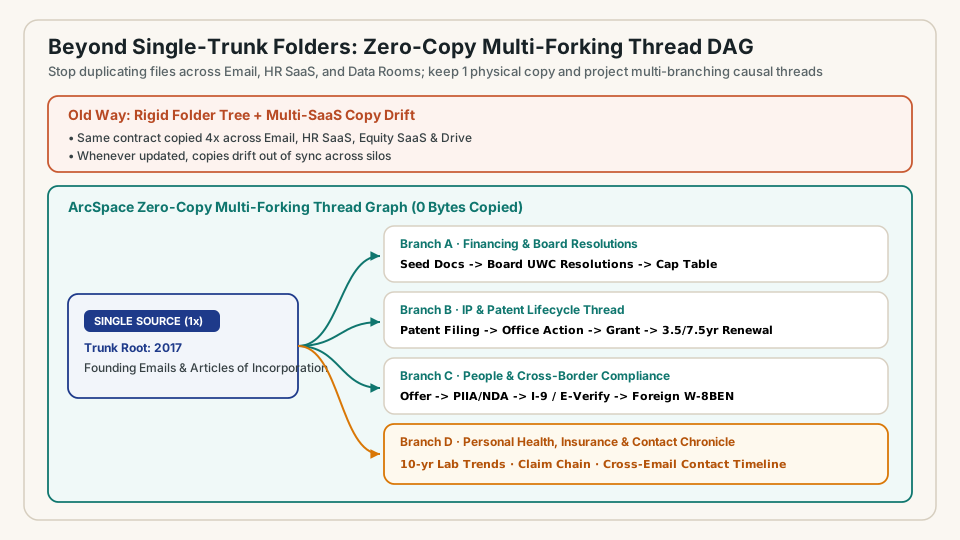
Here is how AI-driven multi-thread discovery transforms both enterprise operations and personal life:
1. Enterprise Scenarios: The Company Chronicle
Starting from early founder emails and the Articles of Incorporation, ArcSpace automatically links related entities, dates, and document references into four interconnected operational threads:
- Financing and Corporate Governance Thread: Seed Term Sheet → Board Unanimous Written Consent (
Board UWC) → Stock Purchase Agreement and signature pages → Cap table updates, giving you an instant end-to-end audit trail for every round; - IP and Patent Lifecycle Thread: Invention disclosure → Provisional filing → Non-provisional application → USPTO Office Actions and responses → Issued patent grant → Mandatory
3.5-year,7.5-year, and11.5-yearmaintenance fee milestones; - Tax and Audit Continuity Thread: Continuous multi-year federal and state tax filings (
2018through2026), quarterly receipts, and audited financial statements; - People and Onboarding Compliance Thread: Every team member's complete chain from
Offer Letter→ signedNDA / PIIA→ archivedI-9 / E-Verifyconfirmation → foreign contractorW-8BENtax certificates.
2. Personal and Household Scenarios: Health and Relationship Chronicles
- Decade-Long Health and Claims Thread: AI automatically links annual physical lab reports, specialist imaging, prescriptions, hospital invoices, and insurance Explanation of Benefits (
EOB) statements by date, provider, and condition into one continuous medical timeline, no more digging through ten year-named folders before a doctor's visit; - Cross-Channel Relationship Timeline: Unifies every interaction with a key business partner, client, or longtime friend across work emails, personal emails, scanned business cards, meeting notes, and signed agreements over a ten-year span.
3. Proactive Audits on Top of Multi-File Threads: Corporate Compliance Gaps, Insurance Policy Traps, and Crypto-Shredding
Once AI has connected isolated PDFs into structured, causal threads, a qualitative leap happens: ArcSpace stops being a passive locker that waits for you to search, and becomes a proactive radar that reasons across linked files to catch missing links, expiring forms, and hidden coverage traps.
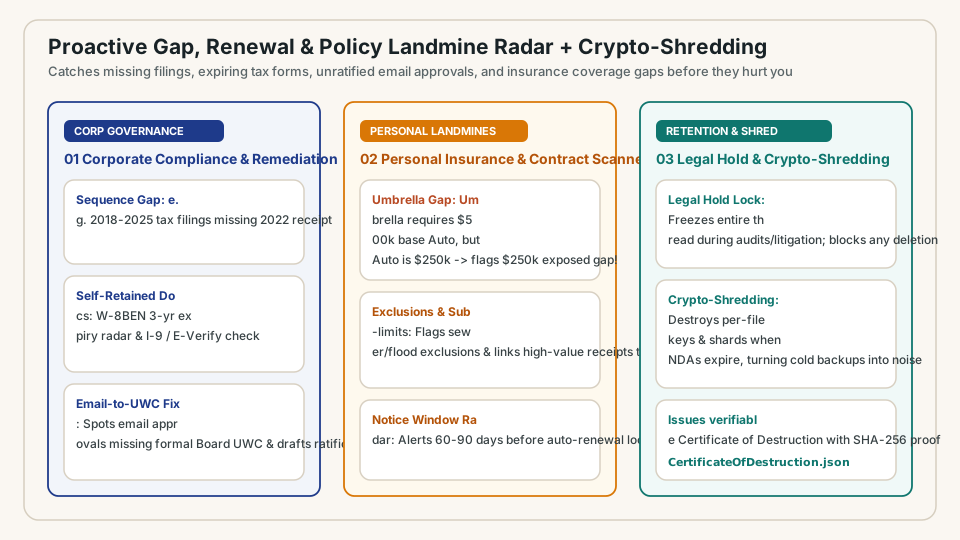
1. Corporate Self-Retained Compliance and Governance Radar
Many teams assume that because they use modern HR or legal SaaS tools, their compliance history is safe. Yet during M&A due diligence or regulatory audits, teams routinely discover painful surprises: the government E-Verify portal purges verification records older than 10 years unless you exported and archived the confirmation PDFs yourself; and foreign contractor W-8BEN forms automatically expire on December 31 of the third calendar year after signing, exposing the company to a 30% withholding penalty if missed.
By auditing each enterprise thread end-to-end, ArcSpace catches governance gaps early:
- Sequence and Onboarding Gap Detection: Automatically flags missing years in multi-year sequences (such as a
2018-2025tax thread missing the2022federal filing receipt) or an employee onboarding thread that has a signedOffer Letterbut no countersignedPIIAIP assignment agreement; - Board Resolution Gaps and Offline Ratification: If a financing or option-grant thread contains an email saying "Approved" but lacks a formal signed Board Unanimous Written Consent (
Board UWC) PDF, ArcSpace highlights the governance gap and uses the Zero-Fact Placeholder Template pipeline to generate a ready-to-sign local ratification draft (attaching the cryptographic hash of the original approval email) without exposing your internal governance gap to any external AI provider.
2. Personal Insurance and Contract Landmine Scanner
Most families buy Auto, Homeowners, and Umbrella insurance policies, drop the 60-page PDFs into a folder, and never read the fine print until an accident happens. By linking all household policies and purchase receipts along the same family protection thread, ArcSpace cross-checks them automatically:
- Catching the Classic Umbrella Coverage Gap: Suppose your
$2MPersonal Umbrella policy states on page 14 that it requires$500,000in underlying Auto bodily injury liability coverage, while your actual Auto policy only carries a$250,000limit. That mismatch leaves a $250,000 out-of-pocket hole that neither policy will cover in a major claim. ArcSpace detects and flags this cross-document gap the moment both PDFs are indexed; - Exclusions and Valuables Sub-Limit Reconciliation: Automatically highlights critical exclusions (such as flood or sewer-backup exclusions in a homeowners policy) and cross-checks policy sub-limits on jewelry, cameras, or fine art (often capped at
$1,500to$2,500) against the actual purchase receipts linked in your archive so you know when an item needs a dedicated scheduled rider; - Auto-Renewal Cancellation Window Alerts: Spots buried 60-day or 90-day advance notice windows in commercial vendor contracts before an unwanted annual auto-renewal locks in.
3. Retention Governance: Legal Hold and File-Level Crypto-Shredding
The final piece of thread-aware lifecycle governance is knowing when a thread's files must be locked against deletion, and when they must be provably destroyed.
Keeping every file forever is not always an asset. Confidential third-party documents received under an external NDA often carry a contractual obligation to destroy all copies upon expiration, and retaining stale third-party PII indefinitely creates unnecessary legal and breach liability.
- During an audit or legal dispute, you can apply a Legal Hold to any business thread or virtual view, locking all linked files and version histories against modification or deletion;
- Conversely, when an expired third-party NDA on a partner thread requires permanent disposal, pressing Delete in your operating system is not enough if encrypted chunks still sit inside six-month-old offsite S3 backups. ArcSpace supports File-Level Crypto-Shredding: destroying the file's dedicated encryption keys and associated shard pointers across the storage pool so any residual fragments on cold backup media instantly become mathematically irrecoverable random noise, complete with a signed Certificate of Destruction attached to the thread.
Summary: Giving Your Digital Space True Memory and Foresight
Across this five-part series, we have walked through the complete engineering architecture behind ArcSpace:
- Cryptographic Anti-Dump Foundation: Unifying DID Wallet, Chain, and ArcSpace at the cryptographic root with two-factor split keys and a blinded shard pool so neither database dumps nor backend admins can inspect your private files;
- Anti-Self-Lockout and Social Recovery Architecture: Combining progressive hybrid encryption, a 4-slot key envelope with sub-millisecond header re-wrapping, 3-second Touch ID self-rescue,
2-of-3Shamir guardians, and an on-chain time-lock challenge window so forgetting a password never turns your data into a brick; - Universal Storage Control Plane: Zero-copy virtual views that organize 132 GB of chaotic files in milliseconds without duplicating bytes, paired with a Dataless Cloud Stub Guard that prevents accidental cloud-drive hydration storms;
- Peace of Mind Backups and Legacy Retirement Visas: Cross-drive content folding, non-destructive Time Capsule harvesting with verifiable Decommission Certificates, and a deterministic 3-2-1 backup loop with a pre-egress privacy gate;
- AI-Driven Multi-Thread Discovery for Enterprise and Personal Scenarios: Moving beyond simple virtual folders with local-first AI that automatically weaves multi-file threads and relationships, powering proactive corporate compliance audits and personal insurance landmine detection.
A digital space that truly belongs to you should be more than a passive locker for files. It should be a private, verifiable, and proactive memory system that understands the threads of your work and life for decades to come.