Where Does ARC Run? A Look at Its Cloudflare Runtime
ARC (Agentic Realm Computer) is an environment that runs applications. Your own computer or server can host it. It can run on Cloudflare Workers, and mobile devices have corresponding native implementations. The application model is shared; each platform has its own way of executing it.
That is the starting point for understanding what Cloudflare does in this setup. Here, I want to explain how ARC runs applications on Cloudflare and how the data space works alongside it.
What is ARC?
A computer needs to access data, execute programs, and present results to its users. ARC organizes those capabilities. In ARC, an application is called a Blocklet. It includes application content, configuration, and execution logic.
You can install an existing Blocklet or have an AI agent create one for your needs. Once the application is ready, it needs an environment to execute its logic and connect it to the data and capabilities it uses. ARC provides that environment.
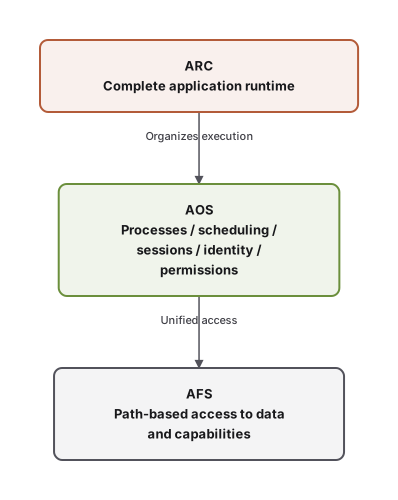
The structure runs from AFS to AOS to ARC. AFS (Agentic File System) is the underlying access interface: applications use paths to reach data and capabilities. AOS (Agentic OS) organizes processes, scheduling, sessions, identity, and permissions above it. ARC brings these parts together into a complete environment for running applications.
AFS, AFS UI, and AUP (Agentic UI Protocol) aim for consistent interfaces and protocols across platforms: how data is accessed and how interfaces are described should not change with the host. ARC can have different runtime implementations, and the AOS capabilities available on each platform can differ. Shared protocols give applications a common way to express their work; what they can actually do still depends on the platform implementation and device capabilities.
Where can it run?
On macOS, Linux, or your own server, ARC can run as a persistent service. That machine executes the Blocklet, and you maintain the environment and its local resources.
Cloudflare Workers is another host, with its own request and lifecycle model and a corresponding ARC runtime adapter. We also have native Swift and Kotlin implementations for iOS, macOS, and Android, including local data access, application execution, and UI rendering.
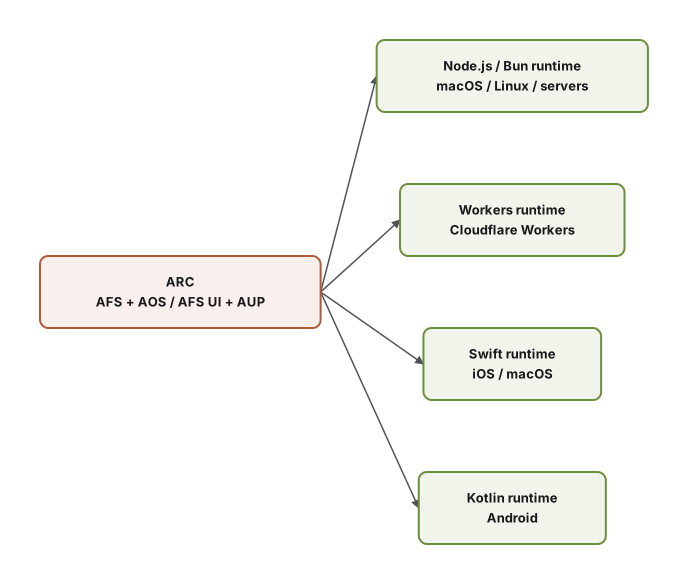
Node.js and Bun are execution environments used by the computer and server runtime; macOS and Linux are operating systems that host them. The Swift native implementation targets iOS and macOS; Kotlin targets Android. They share the protocols and use their respective platform capabilities.
These environments do not all have the same capabilities. Work that uses a camera needs a device with the necessary capability and permission. Work that serves a website can use a server or a cloud environment. Where a Blocklet can run depends on its interfaces, device requirements, and the support available on that platform.
How ARC runs on Cloudflare
Our official online services currently run on Cloudflare.
In this implementation, Workers receives requests and executes application work. ARC's Cloudflare runtime uses the same core as the server runtime, with an adapter connecting it to Workers' execution and session mechanisms. A server has a persistent process; Workers has its own lifecycle. The runtime handles that difference.
Running ARC on Cloudflare therefore involves a dedicated platform adapter. ARC still organizes Blocklet execution and data access, while Cloudflare services host the work underneath.
Sessions handle the ongoing interaction between a user and an application. Compute and storage also have different roles: Workers executes the application, while data the application needs to keep has a space of its own.
Data lives in Arc Space
Arc Space is a user's data space. It holds data and can also hold Blocklet content and configuration. Think of Space as the folder that holds your things and Computer as the machine that uses them to do work.
On Cloudflare, Arc Space uses R2 for content and D1 for directory and metadata management. ARC accesses the space through the corresponding interfaces, and applications use ARC interfaces to access the data. Compute and data each have a host, with the interfaces connecting them.
Space also has a local storage implementation. Where data lives and which environment runs the application can be considered separately. Connecting them still requires a reachable interface and appropriate permissions. Cloudflare storage is one backend for this space model.
Users manage their applications
These parts need to come together in something a person can use.
Through My Arc Space, users can use a hosted data space and manage their data and Blocklets. When a hosted ARC serves the application, the operator configures and maintains the underlying Cloudflare resources. Users do not need to deploy a separate Worker or create an R2 bucket for every application.
Application permissions and credentials for external services still need configuration. Public access requires publishing configuration; a custom domain needs a corresponding domain entry. Hosting reduces the infrastructure users maintain directly, while leaving those application-level choices in place.
If you operate your own ARC environment on Cloudflare, you handle the underlying deployment and maintenance. If you want to manage the machine yourself, you can also prepare a Blocklet and use ARC's command-line tools to start a server runtime.
Back to the opening question: where does ARC run? Your computer, a server, Cloudflare Workers, and native devices can each host a corresponding runtime. AFS, AFS UI, and AUP provide common interfaces and protocols. Each platform runtime connects applications to its compute, storage, and device capabilities.
We currently use Cloudflare to host our official online services: Workers executes applications, and Arc Space's R2/D1 implementation stores data. With hosting through My Arc Space, you manage your applications, data, and permissions while the operator maintains the underlying resources. When you run ARC yourself, you manage the runtime environment too. Understanding that division helps you choose where your application should run.