Millisecond Receipts Without Blind Trust: Consensus Layering, the Verifiable Single Sequencer, and HotStuff-Lite Two-Tier Finality

Distributed systems and blockchain architecture have long been split across a seemingly irreconcilable divide.
On one side are the real-world latency demands of web developers, interactive applications, and autonomous AI agents. When a user taps to pay, claims a credential, or an AI agent settles an API call mid-workflow, they expect the millisecond-level deterministic responsiveness (10ms–50ms) of SQLite or a cloud database—without having their transactions front-run or sandwiched in a public mempool (MEV).
On the other side sits traditional public-chain consensus dogma. To achieve decentralized block production, every sendTx call on the hot path must traverse peer-to-peer gossip across dozens or hundreds of nodes (O(N^2) communication complexity), wait through multi-round voting, and re-execute the state machine before returning a receipt seconds or minutes later. Conversely, many consortium chains and L2 rollups retreat to a single sequencer for speed, yet omit signed checkpoints, independent witness verification, and key separation—leaving users helpless if the sequencer's hot key is compromised or the operator silently edits the database.
As we evolved ArcBlock Chain and Verifiable Ledger, we refused to accept that trade-off. By combining Consensus-Execution Layering, a Three-Branch Separation of Cryptographic Powers, and a seamless transition from a Verifiable Single Sequencer to a 3–7 node star-topology HotStuff-Lite core cluster, we built a two-tier finality architecture that delivers cloud-database responsiveness backed at every step by cryptographic accountability.
1. Consensus Layering: Why the Hot Path Doesn't Need Multi-Node Re-Execution
Traditional blockchains are slow on the hot path because they entangle two fundamentally different problems inside the same consensus round: they force every node to vote on transaction ordering while simultaneously re-executing every complex state transition before acknowledging the client.
As we introduced in Embedded Like SQLite, Verifiable Like a Blockchain, ArcBlock's consensus layering starts from a clean mathematical identity:
Consensus(Ledger) + Determinism(Algorithm) = Consensus(State)We separate the ledger architecture into two distinct planes:
- The Ledger Plane (Consensus on Literal Validity and Order):
Who sent a transaction and what it requests are already locked down by the sender's digital signature. Appending an entry to the Ledger therefore requires only fast literal validation—verifying the signature, canonical format, and monotonic
nonceagainst replay—before assigning a globally monotonicsequencenumber. Whether the sender's balance is sufficient for a complex multi-step contract does not need to hold up ordering, because the only thing consensus must establish is Order. - The State Plane (Deterministic Derivation and Independent Verification):
Once transaction ordering is fixed in the Ledger, state transition is no longer a political question that requires a committee vote—it is a pure mathematical function:
State = f(Ledger, Algorithm). Because the state transition algorithm is deterministic, any independent validator, auditor, or mobile light-verification wallet replaying that exact ledger sequence will derive the exact samestateRootbyte-for-byte.
When two independent nodes derive the same stateRoot, they achieve Double Confirm. If their derived roots ever diverge, one of them has a software bug or a tampered database—and resolving the discrepancy requires no subjective debate, only replaying the immutable Ledger sequence (Rebuild / Resolve).
Decoupling real-time ordering from asynchronous multi-party verification is the key that unlocks two-tier finality.
2. Two-Tier Finality and the Three-Branch Separation of Cryptographic Powers
Drawing inspiration from modern corporate governance—where an executive team makes fast operational decisions while an independent board and audit committee enforce oversight and circuit-breaker authority—we designed the Verifiable Single Sequencer and Two-Tier Finality model:
1. Tier 1: Hot-Path Single Sequencer (Millisecond Soft Confirmation, Zero MEV)
On the real-time sendTx path, transactions flow directly to the single governance-authorized Sequencer (backed by a warm standby replica under lease failover).
- Zero Multi-Round Voting Delay, Zero Public Mempool Front-Running: The sequencer does not gossip unconfirmed transactions to a public mempool or block on external node votes before responding. We treat MEV (Maximal Extractable Value front-running) as a structural flaw to be eliminated by design, not an inevitability.
- Sub-Millisecond Hot-Path Commit: In our local benchmarks (macOS arm64, Bun runtime, SQLite ledger backend),
append + finalizeEntrycompletes in roughly0.18ms–0.26msper transaction. The sequencer returns a signed soft-confirmation receipt immediately upon commit, while window-levelCheckpointconstruction and Ed25519 signing (roughly6.07ms+0.22msper 100-transaction window, or~0.06msamortized per transaction) run asynchronously off the request path.
2. Tier 2: Asynchronous Checkpoint Witness Cosigning and Deterministic Circuit Breakers
Speed never means unchecked power.
Every window (100 transactions by default), the sequencer seals a Checkpoint containing both the transaction Merkle root (txRoot) and the storage-agnostic deterministic state root (stateRoot). Whether the underlying state engine is SQLite or Dolt, stateCommitHash and stateRoot are computed over canonicalized state deltas and receipt digests (binding txStatus, gasUsed, and post-transaction account balances), stripping out wall-clock timestamps and engine-specific noise.
On top of each sealed Checkpoint, the runtime layers Witness Cosigning (QuorumCertificate) matched to the ledger's operating mode:
- For embedded or departmental Sovereign Ledgers (
Ledger Mode), checkpoints can run as1-of-1(self-signed by the instance and streamed to remote backup or anchored periodically to the parent chain); - For Public Backbone and Cross-Organization Settlement Chains (
Chain Mode),k-of-nindependent validators (operated across separate data centers and ecosystem partners) pull the 100-transaction window, replay the state transitions independently, verifyprevCheckpointHashcontinuity along withtxRootandstateRoot, and attach their cosignatures. - Deterministic Security Circuit Breaker: If a compromised sequencer ever attempts to mutate a database balance out-of-band, the
stateRootcomputed by independent validators will immediately diverge from the sequencer's proposedstateRoot. Validators refuse to cosign and trigger a network-wide circuit-breaker alert—preventing corrupted state from ever crossing the finality threshold to deceive light wallets or cross-chain bridges.
3. Three-Branch Separation of Keys: Why Stealing the Server's Hot Key Cannot Hijack the Chain
The fatal flaw of most single-sequencer and consortium chains is that the online hot key sitting in server memory holds omnipotent authority: if an attacker breaches the host and extracts the environment variable, they can not only sign bogus blocks, but also sign a key-rotation transaction to lock out the legitimate owners permanently.
To eliminate that single point of catastrophic failure, we split chain cryptography into a strict Three-Branch Separation of Powers (rolling out across staged governance milestones):
| Key Role | Custody & Security Posture | Exclusive Legitimate Authority | Hard Constitutional Constraint |
|---|---|---|---|
| 1. Governance Root Key | Offline cold custody, protected by hardware Passkey multi-sig policies (Passkey Policy) | Sole authority to sign sequencer hot-key rotations, validator roster updates, and protocol upgrades | Never participates in online block production; zero network exposure |
| 2. Sequencer Hot Key | Online in primary sequencer memory | Authorized only to order daily transactions and propose Checkpoints | Strictly forbidden from rotating its own key or modifying the validator roster |
| 3. Witness / Validator Keys | Isolated on independent verification replicas | Authorized only to cosign Checkpoints that pass independent deterministic replay | Cannot propose transaction ordering; triggers circuit breaker on state mismatch |
Under this separation of powers, even in a worst-case server breach where the sequencer hot key is leaked, the attacker cannot forge a valid QuorumCertificate past the independent witnesses and cannot rotate governance control. The operators simply use their offline hardware Passkeys to sign a rotation command, revoking the compromised hot key and promoting the standby sequencer in seconds.

3. From N = 1 to N = 3..7: The Star-Topology HotStuff-Lite Core Cluster
When a verifiable ledger evolves from a single-organization deployment into a multi-stakeholder settlement backbone, how does it upgrade from a single sequencer (N = 1) to a Byzantine fault-tolerant (BFT) cluster without breaking a single client or wallet?
To make that transition seamless, we built the HotStuff-Lite Core Cluster Consensus Engine (N = 3–7) directly into @ocap/ledger-core.
1. Why Cap the Core Ordering Cluster at 3–7 Nodes?
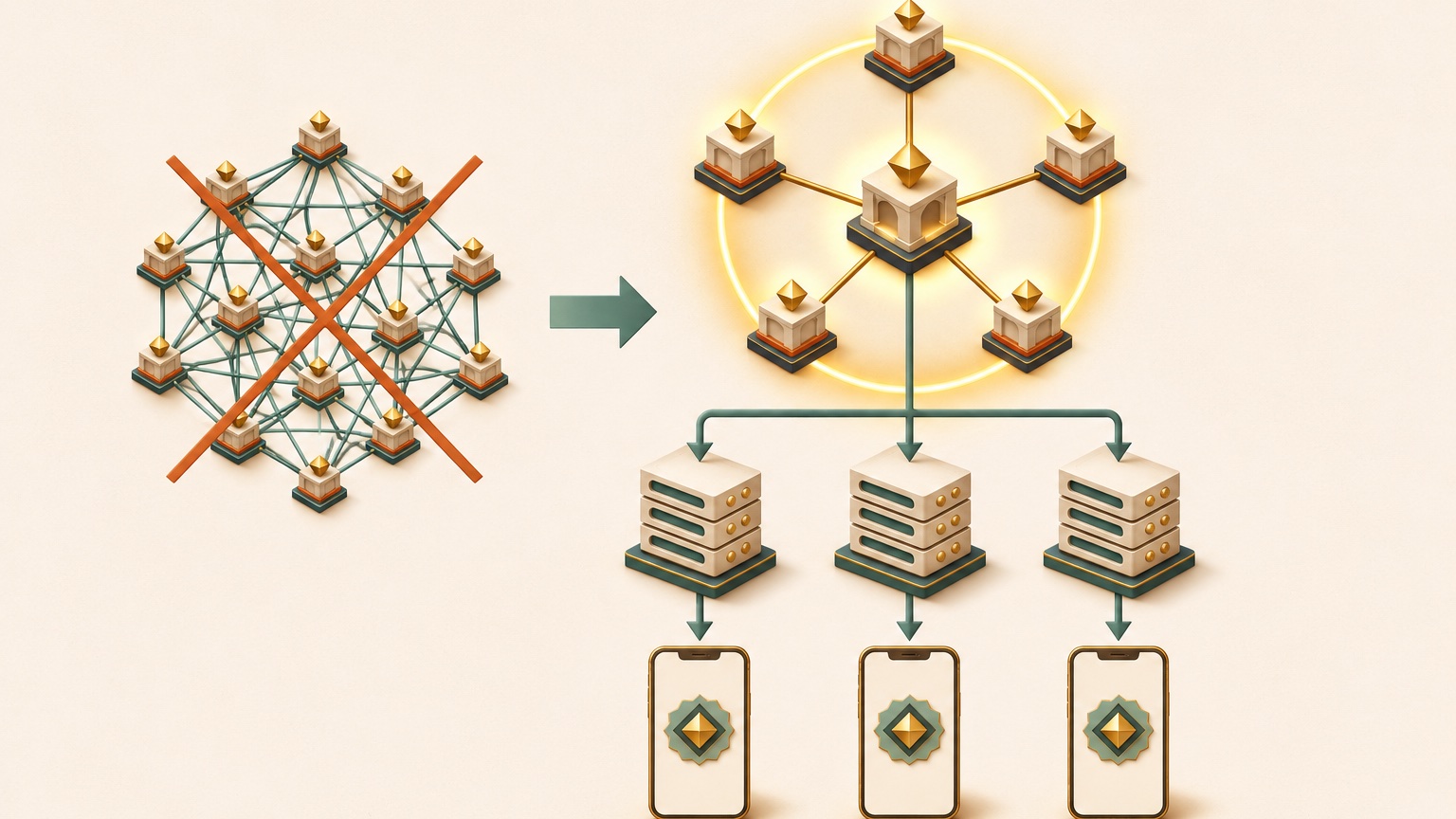
Many public blockchains market "thousands of consensus validator nodes" as a badge of decentralization. Anyone who has operated BFT networks in production knows the reality: running all-to-all gossip across a hundred CometBFT/Tendermint nodes incurs O(N^2) message amplification, saturates bandwidth, and still concentrates real security in a handful of top stake-holders while the remaining nodes act as passive followers.
Our engineering boundary is deliberate: we decouple the limitless outer ring of read/verification replicas and light wallets from a tight, high-accountability core ordering cluster of 3–7 stakeholder nodes.
Keeping the core cluster at 3–7 nodes (for example, multi-region primary data centers plus 2–5 core institutional or ecosystem partners) lets us replace all-to-all gossip with a clean Star Topology:
Tier 1: HotStuff-Lite Core Cluster (N = 1 or 3..7 Validator Nodes)
  [ Validator 2 ] ◄── Proposal ──► [ Leader (View v) ] ◄── Proposal ──► [ Validator 3 ]
         │                                  │                                  │
         └────────── Vote (Ed25519) ────────┴────────── Vote (Ed25519) ────────┘
                                            │
                       1 RTT (20~50ms): Aggregate >= threshold votes into QuorumCertificate (QC)
                                            │
         ┌──────────────────────────────────┼──────────────────────────────────┐
         ▼                                  ▼                                  ▼
[Archive DA Mirrors] [Community Read Replicas] [Million Light Wallets]- Communication Complexity Drops from
O(N^2)to StrictO(N): In viewv, once the Leader assembles a Checkpoint proposal (IHotStuffProposal, protected by cryptographic domain separation"arcblock:hotstuff:proposal:v1"), it dispatches the proposal over2–6direct point-to-point RPC streams. - Single Round-Trip (
1 RTT,~20ms–50ms) to Form aQuorumCertificate: Each validator independently verifiestxRoot,stateRoot,prevCheckpointHash, andhighQCcontinuity before signing a domain-separated Ed25519 vote ("arcblock:hotstuff:vote:v1"). Once the Leader collects the BFT quorum threshold (floor(2N/3) + 1—e.g.,3of4, or5of7), it aggregates the signatures in lexicographical validator order into a deterministicIQuorumCertificate (QC).
2. 100% Protocol Isomorphism with Single Sequencer: Zero-Disruption Upgrades
The cleanest property of this design is that N = 1 is simply a degenerate special case of HotStuff-Lite:
- In single-sequencer mode (
N = 1, threshold = 1), the Leader's own signature forms a valid1-of-1IQuorumCertificate; - When the network scales up to a
4-node or7-node BFT cluster, governance updates theIHotStuffClusterConfigroster. Downstream archive mirrors, read replicas, and millions of mobile light-verification wallets do not change a single line of verification code—they call the exact same pureverifyQuorumCertificate(qc, clusterConfig)function and verify the quorum in under1ms.
3. Pacemaker View-Change and Self-Contained Equivocation Proofs
What happens if the Leader of view v crashes or loses network connectivity?
TimeoutCertificateand thewinningHighQCSafety Rule: If no QC is formed within the view timeout window (e.g.,1500ms), validators broadcast a signedIHotStuffTimeoutMessagecarrying their highest observedhighQCto the next rotating Leader for viewv + 1. Once the new Leader aggregates a thresholdITimeoutCertificate (TC), its first proposal must attach thatTCand setprevCheckpointHashstrictly to the highestwinningHighQC.checkpointHash—making it impossible for a view change to roll back or skip committed history.- Single-Packet Cryptographic Equivocation Proof (
IHotStuffEquivocationProof): If a Byzantine node or rogue Leader ever signs two conflictingcheckpointHashvalues at the same(chainId, viewNumber, height), any observer can pass the two votes intodetectHotStuffEquivocation(voteA, voteB, clusterConfig)to produce a self-contained cryptographic fraud proof that triggers immediate circuit-breaker isolation and governance removal.
4. Edge Shields, External Timestamp Anchors, and Honest Node Economics
Around the core ordering cluster and HotStuff-Lite quorum certificates, we enforce three pragmatic operational boundaries:
1. Public Traffic Terminates at the Edge Gateway; Origin Nodes Never Sit Exposed
In production deployments, core sequencer nodes and state databases are never exposed on public DNS:
- All public client, mobile wallet, and external agent requests terminate at Cloudflare Worker Edge Gateways;
- Sealed
Checkpoints, Merkle inclusion proofs, and anchor receipts are published to edge object storage (R2) and edge caches, serving massive read fan-out at the edge without touching the write-path state engine; - While an edge gateway can rate-limit abusive traffic, it can never forge a
Checkpointwith a validQuorumCertificate. If a compromised edge worker tries to alter a single byte of response data, the user's light-verification wallet catches the invalid proof in0.05msand drops the response.
2. External Timestamp Anchoring: Locking Irreversible History in Under 100 Bytes
To prevent even a hypothetical collusion of every core cluster member from rewriting deep history months later, the network asynchronously anchors its latest Checkpoint digest (a ~64-byte payload) onto high-trust external public ledgers (such as Bitcoin or a parent settlement chain).
External anchoring never blocks millisecond checkpoint production on the local chain—even if the external network is congested—yet once confirmed, it drives an irreversible cryptographic wedge into the global public timeline.
3. The Node Operator's Ledger: Why We Reject Inflationary Block Rewards
Many public chains subsidize thousands of idle nodes by printing inflationary token rewards. The result is predictable: mercenary operators with zero genuine business on the chain farm subsidies until emissions drop, then shut down their servers—or worse, capture protocol governance to preserve their issuance rent.
In ArcBlock's architecture, there is no anonymous mining, no inflationary block reward, and no punitive slashing for read replicas. The operational economics are transparent:
- Everyday Users and AI Agents: Mobile wallets and agents act as light verification nodes. They pay zero server bills, lock zero stake, and protect their assets using sub-kilobyte Merkle proofs.
- Ecosystem Applications and Enterprise Partners (Read Replicas & Core Witnesses): Why does an enterprise gladly pay the cloud bill to run a dedicated read replica or serve as one of the
3–7coreHotStuff-Litewitnesses? Because its own business, revenue, and customers run on that ledger. Operating a replica or witness seat gives the enterprise dedicated, unthrottled local read throughput, immunity to public gateway jitter, and the ability to hand its customers locally verified cryptographic proofs.
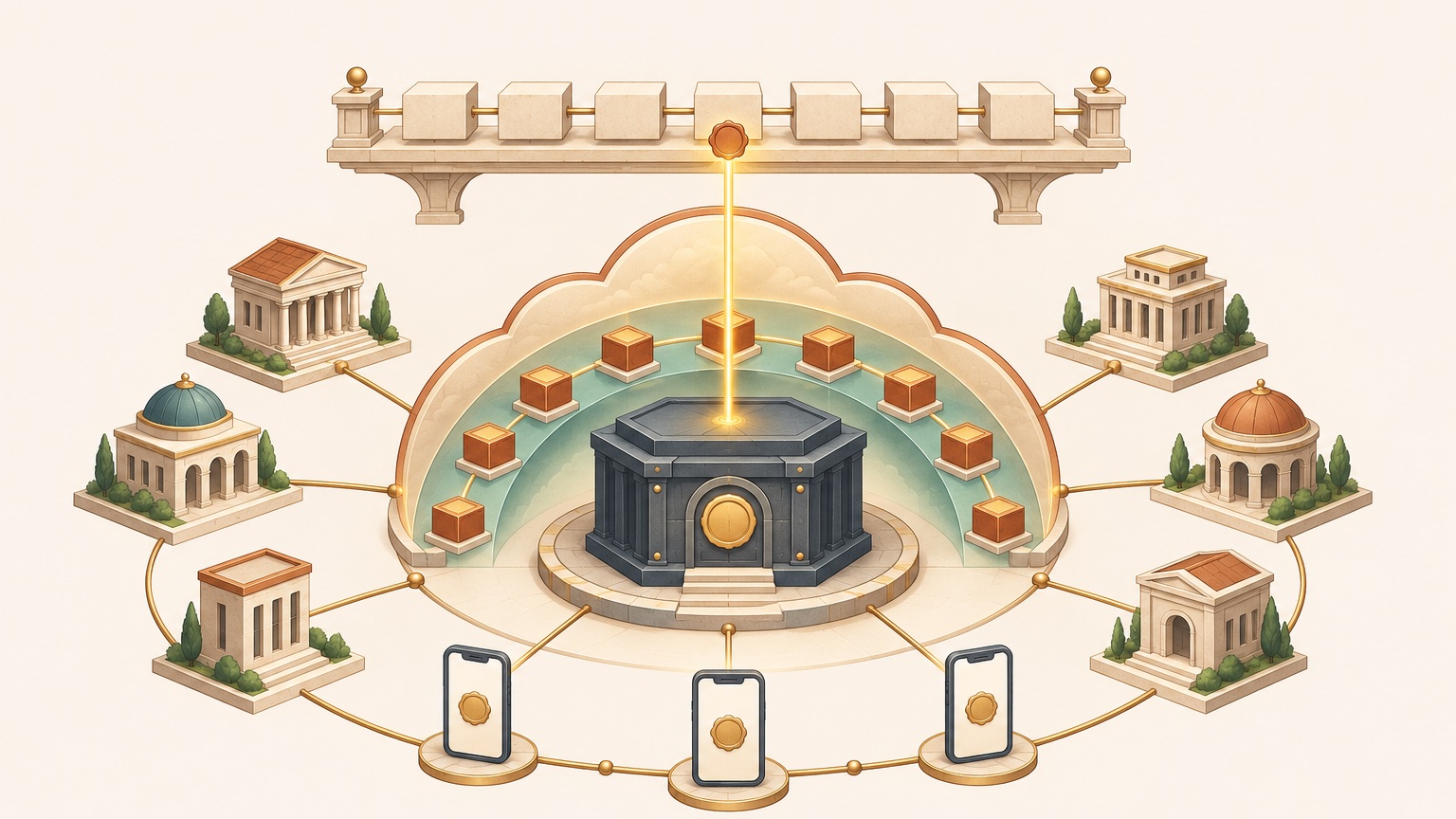
Consensus is not politics; it is verifiable governance. When the stakeholders who depend on business continuity guard the core cluster—and millions of light wallets verify every proof at the edge—a ledger achieves durable engineering security without inflationary bubble economics.
5. Closing the Batch 1 Trilogy
With this article, the first three-part arc of our verifiable ledger deep dive is complete:
- In Part 1, we distilled the blockchain down to a lightweight Verifiable Ledger Core embedded inside every ARC, uniting local process logs, sovereign enterprise ledgers, and public settlement chains into three concentric rings;
- In Part 2, we placed that same kernel inside every human and AI agent endpoint, turning generalized wallets into light verification nodes backed by an isomorphic local mini-ledger and a sovereign encrypted annotation ledger;
- In this third installment, we showed how consensus-execution layering, three-branch key separation, and a star-topology
HotStuff-Litecore cluster deliver millisecond soft confirmations alongside BFT finality.
In Batch 2 of this series, we will move up the stack into identity, credentials, and binary representation—exploring native Passkey P-256 hardware signing and zero-trust cross-chain control planes, Transaction-as-Credential with O(1) bitstring status lists and zero-knowledge proofs, and Deterministic CBOR (RFC 8949) with hash-anchored compact envelopes.