ARC treats a package and an instance as different objects. Confusing them blurs source ownership, configuration, data, and release.
Package versus instance
| Package | Instance | |
|---|---|---|
| What it is | Versioned, reusable application artifact | One configured run or deployment of a package |
| Typical identity | id / did / version in blocklet.yaml | Runtime binding: port, host, owner, data mounts |
| Mutability | Source + published tree at a version | Config and data can change while the package version stays fixed |
| Local evidence | Directory with blocklet.yaml (or convention entry), arc blocklet inspect | arc blocklet run / arc service start --blocklet serving URLs |
| Build product | dist/ + .afs/manifest.json + blocklet.dist.json | Not produced by build alone — requires a serve or deploy step |
| Analogy | npm package / container image | Running container / deployed service |
Code-backed anchors (ArcBlock/arc, package types and CLI):
- Package shape:
blocklet.yamlparsed asBlockletManifest(packages/core/src/blocklet/types.ts) - Scaffold writes package identity (
specVersion,id,name,did,version) viaarc blocklet create - Local instance serve:
arc blocklet run <path>registers the parent directory with the daemon and prints access URLs - Build stamps instance requirements into the flat manifest (e.g.
instance.required: falsefor abasicpackage;minimal-appbuild reportsinstance: requires /instance DID Space)
Diagram
| Stage | Object | Typical command |
|---|---|---|
| Author source | Package source tree | editor + create |
| Validate / package | Package contract + dist/ | check, build, inspect |
| Local run | Local instance | blocklet run / service start --blocklet |
| Remote path | Remote instance | deploy --server / Pages — separate, often experimental |
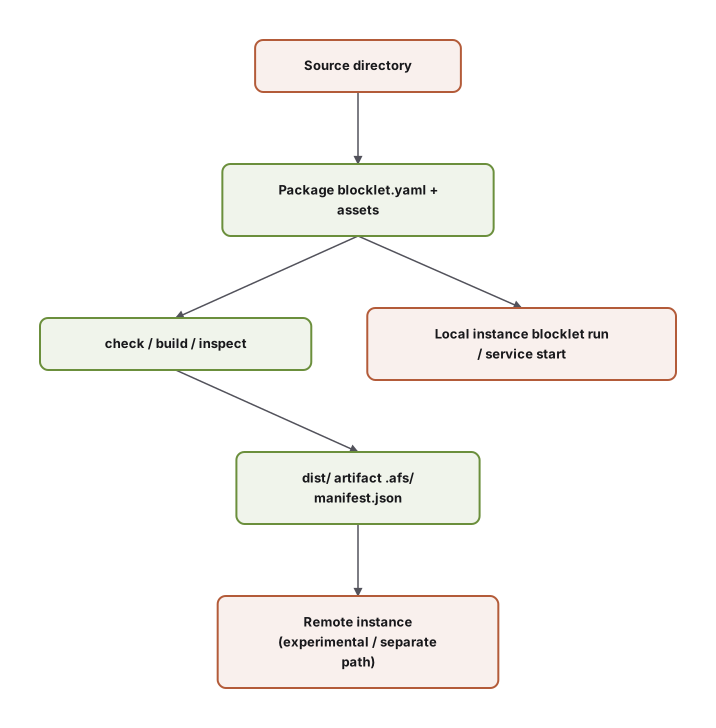
A package is the versioned application unit. An instance is a particular run or deployment of that package.
What belongs where
| Concern | Lives on the package | Lives on the instance |
|---|---|---|
blocklet.yaml identity, scope, mounts, sites, replicated declarations | Yes | No (read as declared by the package) |
Built file tree under dist/ | Yes (artifact) | Consumed when deployed |
| Daemon port, extra blocklet dirs | No | Yes |
/instance DID Space data (when required) | Seed only (seed/) | Runtime data ownership |
| Domain binding for a public deployment | Declared candidates (sites.domains) | Actual binding for this deployment |
Manifest fields that name the split
From the current parser (BlockletManifest):
| Field | Package meaning | Instance implication |
|---|---|---|
id, did, version, specVersion | Package identity | Stable package coordinates for a run |
scope | Namespace visibility model (app default, also user / root / agent) | Session AFS shape for the run |
instance.required / instance.mount / instance.seed | Declares whether a real /instance DID Space is required | Runtime must fail closed if required and missing |
mounts | Provider dependencies declared by the package | Mounted into the running AFS |
sites / surfaces | Declared routing and exposure | Resolved by the host that serves the instance |
replicated | Collection contracts in the package | Writes and copies at instance/user spaces |
Minimal package written by arc blocklet create --recipe basic (verified):
specVersion: 2
id: demo-basic
name: demo-basic
did: did:blocklet:demo-basic
version: 0.1.0
description: ""
After arc blocklet build, the flat manifest for that package included:
{
  "specVersion": 2,
  "id": "demo-basic",
  "instance": { "required": false, "mount": "/instance" },
  "scope": "app",
  "mounts": []
}
Local instance without remote deploy
A local instance is enough for acceptance:
arc blocklet run ./demo-min
# or
arc service start --blocklet ./demo-min --port 4939
Verified (2.0.0-beta.28; seed-instance port override, today prefer a named instance):
Serving blocklet "demo-min" on port 4941
  http://demo-min.localhost:4941/
  http://localhost:4941/?blocklet=demo-min  (Safari / universal)
GET with Host: demo-min.localhost:4941 returned HTTP 200. No DID Space publish was required.
Rules of reading
- Source edits change the package. Rebuild and re-check when you change declared files.
- Runtime state belongs to the instance environment (daemon config, ports, DID Space data). Do not treat a successful local serve as proof that a remote instance is healthy.
instance: requires /instance DID Spaceon a build means stateful features of that package need a real instance space. Local HTTP 200 on a shell page does not prove those writes work — see Publish and deploy and Data and AFS.
Next: Create and run locally.