Interview with ArcBlock Founder Robert Mao: Crypto’s Fundamental Problem Is the Gap Between Power and Responsibility
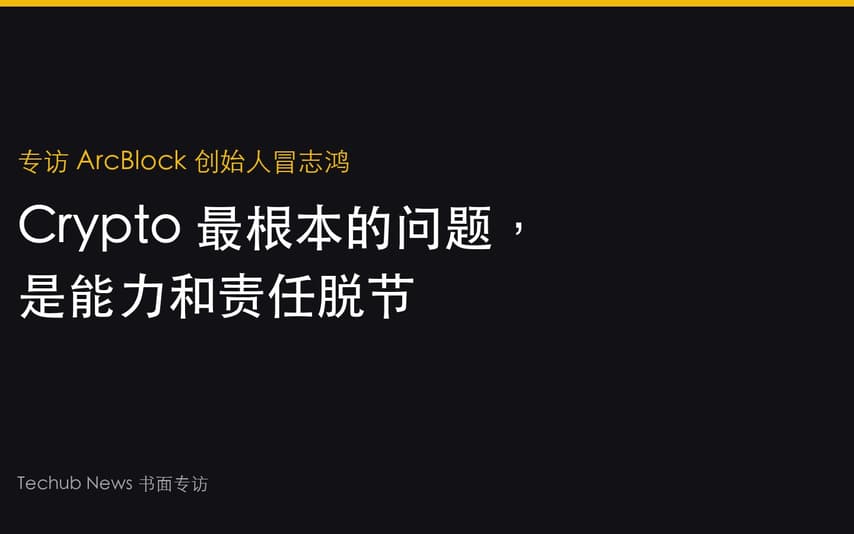
Originally published in Chinese by Techub News on November 3, 2026. Interview and article by Alma Li. Read the original report.
This English translation was prepared by ArcBlock from the full text supplied by Robert Mao. The interview, editor’s notes, and disclosure of verification limits are retained. The original Chinese-language cover is from Techub News.
Introduction
After the theft from Binance’s hot wallet, ArcBlock founder and CEO Robert Mao, known in the industry as “Lao Mao,” published a call to action titled Crypto Cannot Go On Like This: A Blockchain Builder’s Call for the Industry to Save Itself. He laid out a timeline of incidents from Mt. Gox, Bitfinex, and Coincheck through to Binance, urging exchanges, wallets, protocols, and security builders to rebuild the foundations of asset control and security verification so that the damage from a single intrusion is contained. Techub News republished the call on October 31.
After its publication, Techub News CEO and founder Alma Li interviewed Mao in writing. The questions ranged from why he was speaking out now and how responsibility should be divided across the industry, to ArcBlock’s own mistaken judgments, how security principles should work in products, and what AI has changed. Asked what he felt most strongly when he wrote “Crypto cannot go on like this,” Mao answered: “Mostly, that we finally have the ability to change things.”
Key Takeaways
- Mao sees crypto’s fundamental problem as a disconnect between power and responsibility: systems grant extensive authority over assets without corresponding constraints, then shift responsibility to users when things go wrong. He argues that “Why can one intrusion move so many assets?” matters more than “Which vulnerability was it this time?”
- Whoever designs and controls a part of the system must explain how it protects users, Mao says. When users follow the product’s instructions and still fall into a trap created by its design, the product bears responsibility. “They clicked confirm” cannot explain away every failure, and self-custody should not require everyone to become a security expert first.
- Mao says ArcBlock’s most consequential misjudgment was being too optimistic about decentralized applications and the maturity of the Ethereum ecosystem. The broad application ecosystem it expected has yet to emerge. Starting again, he would test the platform against concrete application needs much earlier.
- If an existing trading platform could change only one thing, Mao would first separate its everyday trading systems from authority over large reserves. An independent layer must still be able to reject abnormal withdrawals after the business systems are compromised, and automatic hot-wallet replenishment must not provide a way around the limits.
- Mao says ArcBlock’s core contribution would be the fully automated software factory it has built. The first step is a public specification and prototype: how can a wallet resist being emptied all at once after its everyday transaction key has been compromised? Independent teams should try to bypass the protections. The timetable will follow a clearly defined scope of work.
- Whether others join will not determine whether ArcBlock starts, Mao says. A year from now, the initiative’s value should be judged by actual adoption by outside teams, independent adversarial testing, and whether the scope of asset exposure has measurably been limited.
Why Speak Out Now?
Alma: When you wrote “Crypto cannot go on like this,” what did you feel most strongly?
Robert Mao: Mostly, that we finally have the ability to change things. These problems have been happening over and over for a long time. We could see them and knew things should not work this way, but it was hard to believe a small team like ours could change much.
AI has changed that premise. Today, the engineering capacity one person can draw on with coding agents is getting closer to what used to take an experienced team. When something like this happens again, my thought is: we now have the means to act. Infrastructure that once seemed beyond our resources is worth reassessing. That is the main reason I wrote the article.
Alma: When you first entered the blockchain industry, what problem did you really want to solve?
Robert Mao: I have always cared about whether users can truly own their data, identity, and assets. In 2017, we saw a major opportunity in decentralized applications, while much of the industry’s effort was still going into trading and token speculation. Applications were hard to build, and the development tools were poor. We thought that was exactly the problem ArcBlock could solve.
That starting point has not changed. But we were too optimistic about how quickly an application ecosystem would emerge and how the underlying technology would mature. Control is worth pursuing. Getting ordinary people to want to use something still takes a product that answers their needs.
Alma: Have you had moments when you saw a direction early, but the market did not arrive as expected? How do you decide whether to persist or adjust?
Robert Mao: ArcBlock itself is a direct example. We built an application platform ahead of demand, expecting more and more developers to arrive. The market did not grow the way we imagined.
I separate long-term goals from specific approaches. I still believe users should own their data. The products and entry points we use to get there can change. “We were early” does not explain everything. If a product’s value always depends on a major trend that has not happened yet, that premise needs another look.
Alma: How do you define yourself? What would you choose when the company’s interests and the industry’s public interest do not fully align?
Robert Mao: I am still a founder who likes making things. The company needs a healthy industry to grow, and those interests are often connected.
We can make a practical contribution to this initiative. We have built a fully automated software factory and accumulated substantial experience in AI engineering. We are willing to put that experience into public infrastructure. If something we have used and tested ourselves can help other builders avoid some detours, I think that is a worthwhile contribution.
The Industry’s Problems and Builders’ Responsibilities
Alma: If you had to choose one, what is crypto’s most fundamental problem today?
Robert Mao: I think power and responsibility have become disconnected. Systems allow extensive authority over assets without corresponding constraints. When something goes wrong, responsibility gets passed to the user. Why can one intrusion move so many assets? That question matters more than “Which vulnerability was it this time?”
Technology and incentives reinforce each other. Take sandwiching users’ trades through control over transaction ordering. Once someone can make money from it, the industry is inclined to treat it as a mechanism worth keeping. I think behavior that harms users should be treated as a problem to fix. Generating revenue should not end the questioning.
Alma: You object to blaming incidents on users failing to protect their private keys. How, specifically, should responsibility be divided?
Robert Mao: One basic principle is that whoever designs and controls a part of the system must explain how it protects users. Wallets must explain authorizations clearly. Protocols must constrain permissions. Platforms must separate their operational systems from control over assets.
Users have responsibilities too. But we cannot expect them to check a vendor’s random-number generation, supply chain, or contract code. If users follow the product’s instructions and still fall into a trap in its design, the product has responsibility to bear. “They clicked confirm” cannot be a universal explanation.
Alma: Has the industry packaged “taking no responsibility” as “decentralization”?
Robert Mao: Yes. Asking users to write down a seed phrase, insisting that they must never lose it, expose it, or be tricked into disclosing it, then blaming them for every subsequent failure is irresponsible design.
Giving users real control should also let them limit authorization, recover access, and change services. If even professional teams struggle to identify a risk, we cannot assume an ordinary person understands it after reading a pop-up. Self-custody should not require everyone to become a security expert first.
Alma: Is the biggest obstacle to rebuilding the industry a lack of technical capability, or existing participants’ unwillingness to change?
Robert Mao: Many protections already have a technical foundation. The difficulty is making them the default and having someone maintain them. Existing participants also face migration costs and have their own interests. We cannot assume everyone will adopt a good solution as soon as they see it.
I also reject the premise that greater security must make a product harder to use. Everyday small transactions can remain convenient, while large transfers and expanded permissions require stricter conditions. A narrowly scoped pilot that measures the extra cost and reduced risk is more realistic than asking the whole industry to start over together.
ArcBlock Must Face the Same Scrutiny
Alma: Applying the call to action’s standards to ArcBlock, where are you most confident, and where do you most need to improve?
Robert Mao: I am most confident that we have built solid foundations over the years and earned respect among people doing real technical work. DID is one example. In 2019, we were already participating in the W3C Credentials Community Group and had joined DIF, while building decentralized identity into our products. In 2022, DID Core became a formal W3C standard. In 2025, a representative of our company was elected to DIF’s Steering Committee.
I also serve on the Cascadia Blockchain Council’s Steering Committee. In 2025, we visited Japan as part of Washington State’s trade delegation. This year, I just gave a keynote at the ASE conference in Munich. From the identity technology community to business partners, government, and academia, we have built long-term relationships and trust.
We are now extending that work into AI and a fully automated software factory. Our existing products and engineering practice give us the confidence to contribute to this effort. The next step is to apply that capability to concrete asset-security problems, so the protections can be independently tested and adopted by other teams.
Editor’s note: DID Core (Decentralized Identifiers v1.0) became a formal W3C Recommendation on July 19, 2022. According to DIF Newsletter #55, published by the Decentralized Identity Foundation on November 12, 2025, ArcBlock’s Matt McKinney was elected a new member of the DIF Steering Committee. The ASE event in Munich that Mao refers to was the IEEE/ACM International Conference on Automated Software Engineering, ASE 2026. According to the conference website, he delivered a keynote on October 12 at its Harness4GenUI workshop, titled “What Endures When Everything Evolves? AFS-UI and the Search for Stable Foundations in Generative UI.”
Alma: What has been ArcBlock’s most consequential mistaken judgment over the years?
Robert Mao: If I had to choose one, it would be being too optimistic about the development of decentralized applications and the maturity of the Ethereum ecosystem.
In 2017, we thought Ethereum’s poor performance and developer experience were growing pains, and that its security and architecture would keep improving. We would solve the difficulties of application development and be ready for the ecosystem’s growth. Yet today, beyond uses such as trading and stablecoins that have reached scale, the broad application ecosystem we expected has not emerged.
That was a mistaken judgment about a major market premise. But we have kept building applications ourselves. Our work on identity, data, and application platforms has practical uses and gave us a foundation for the AI opportunity that came later. We now see that work producing new value. Starting again, I would test the platform against concrete application needs earlier, rather than make the maturity of the whole ecosystem a prerequisite.
Alma: Setting token prices aside, how should outsiders judge whether ArcBlock has created value?
Robert Mao: Look at the products we have actually built, the technical foundations we have accumulated, and the people who work with us over the long term. Our DID work has become part of the broader digital identity community. Now the fully automated software factory has moved our engineering capability a substantial step forward. Those are tangible results that people can discuss and examine.
For our early supporters, I think our continued work over these years shows we have taken their trust seriously. When judging product value, I put more weight on continued use, adoption by independent developers, and customers actually paying. The trust we have built in standards communities, business partnerships, and academia also shows that professional peers recognize the work.
Alma: How do you understand the relationship between the company, product users, and token holders?
Robert Mao: Those roles overlap, but they also have different concerns. Users care whether a product is useful. The company needs to keep operating. The token’s function in the protocol also needs a clear explanation. We cannot mix all of that into one vague idea of “ecosystem development.”
Being responsible to supporters starts with explaining progress, limitations, and actual uses clearly. When a technical feature ships, describe honestly what problem it solves. Product progress must not be packaged as a promise of investment returns, and market sentiment cannot replace a judgment about whether the product is useful.
Alma: How do you prevent “long-term building” from becoming an excuse to avoid results? What deadlines have you set yourself?
Robert Mao: Long-term building has to keep producing new results. We cannot just repeat a vision from many years ago. From a decentralized application platform to DID, then AI and the fully automated software factory, we have kept turning technical work into products and engineering capability.
We also adjust our approach as markets change. The decentralized application ecosystem did not mature as expected, but the need for identity, authorization, and data control has remained. AI has brought those problems into much broader settings. I prefer to judge investment of effort through concrete business needs and results at each stage, rather than set one countdown for every direction.
How Security Principles Become Products
Alma: How do you prove these are better security principles, rather than just an argument for another technical approach?
Robert Mao: Put different implementations under the same attack conditions and explain what each protects and what it costs. That is what the initiative is meant to do.
I criticize dependence on the EVM path, and I also wrote explicitly that non-EVM systems get no security exemption. A different network name proves nothing about safety. Every implementation, including ArcBlock’s, should be judged by implementation and tests. If someone has a better method, adjust according to the evidence. Building together cannot depend on using our products.
Alma: Who sets and changes asset limits? What happens if the protective mechanisms themselves fail or are abused?
Robert Mao: Rules should be authorized by the asset owner. Who can pause, who can restore access, and how to change protection services must be clear in advance. The key point is that the everyday transaction key must not also be able to cancel the rules protecting it. Expanding permissions requires independent authorization, as well as time to detect abnormalities and revoke the change.
A recovery service must not hold a new master key, either. Users should have a way to exit or migrate under terms agreed in advance, and that path must itself face adversarial testing. A security mechanism must not gain unlimited, inescapable control over users’ assets in the name of protection.
Alma: How can trading services reduce centralized custody? If an existing platform could change only one thing, what would you choose?
Robert Mao: I would first truly separate everyday trading systems from authority over large reserves. After the business systems are compromised, an independent layer must still be able to reject abnormal withdrawals. Automatic hot-wallet replenishment must not provide a way around the limits.
Spot trades that can be completed under clear settlement conditions can gradually reduce custody. Users authorize what they will give up, the minimum they must receive, and when the authorization expires. The service gets only the permissions needed to complete that trade. Businesses that still depend on centralized accounts and credit need separate treatment. One approach will not fit them all. Pilots should measure the efficiency cost. Risk reduction should be measured by the maximum assets accessible after one entry point is compromised.
Alma: There are no absolute security guarantees. What should a responsible product promise users?
Robert Mao: It should explain what it can protect under specific conditions. As an illustrative example, after an everyday key is stolen, no more than 1,000 yuan can be transferred each day. Raising that limit requires another authorization path and a waiting period. That “1,000 yuan” has to survive attempts to bypass it. It cannot just be a setting on a page. The product must also explain whether protection still works if the monitoring service goes offline.
Before depositing assets, users should at least be able to establish their exposure if permissions are compromised, find out who can change the rules, and actually rehearse recovery. Products should make those boundaries clear rather than offer only a line about “advanced security technology.”
What Has AI Changed?
Alma: Why do you think AI changes the feasibility of rebuilding the industry?
Robert Mao: Because we have built a fully automated software factory ourselves, and it has substantially improved our software development efficiency. We use that capability every day, so I am confident that AI can change how the industry builds. Work that once required an experienced engineering team is now within reach of individuals and small teams.
We started working on AI in 2023 while continuing to build blockchain, DID, and application infrastructure. When it comes to combining AI and blockchain, I think few teams in the industry have done as much sustained, practical work on both sides as we have.
That is an important strength we can contribute to this initiative. We are willing to share our software-factory experience and help turn security requirements into systems that can be implemented, tested, and continually improved. It gives us room to reassess both the cost and the pace of building public infrastructure.
Alma: AI can also produce vulnerabilities faster. How do you prevent so-called independent verification from simply confirming the same blind spots?
Robert Mao: Part of a fully automated software factory’s value is organizing checks, tests, and corrections into an engineering process that can keep running. When development becomes more efficient, we can spend more effort on verification instead of using it all on implementation.
Of course, running more agents does not automatically count as independent verification. Similar models can share blind spots. We need reproducible tests, comparisons between different implementations, and adversarial testing by independent researchers. Acceptance depends on actual results, not just an agent’s report. People set the goals and security boundaries, and bear responsibility for the final delivery.
Alma: If AI and traditional software alone can meet a need without blockchain, what would you choose?
Robert Mao: Then leave blockchain out. Ordinary content generation and personal tools do not need a chain added just because there is an AI feature.
Blockchain deserves serious consideration when several parties that do not fully trust one another jointly operate assets and verify settlement, without wanting any one of them to be able to change the records unilaterally. What is needed there is a set of rules everyone can verify. Agents need identity and authorization, but that does not mean every model call must go on-chain. Define the problem first, then choose the tool. Otherwise, all you add is complexity.
Alma: As development gets cheaper, will basic software become harder to charge for? Where does ArcBlock’s value lie?
Robert Mao: If the value is only “we can write this code,” the ability to charge for it will certainly be affected. But easier code generation also means more applications and more AI agents needing identity, data spaces, authorization, and a foundation for continuous operation. Those are exactly the areas we have been working on for years.
Our strength is that we have gone deep on both sides. Blockchain and DID are long-standing foundations. We began working on AI in 2023, and now the fully automated software factory has greatly improved product development efficiency. I think that combination of technical foundations and engineering capability is very competitive in the industry.
Customers care whether they can build applications faster, keep them running, and retain control of their data and permissions. We need to turn those capabilities into products customers want to use and pay for. Easier software generation creates a broader range of uses for those foundations.
From a Call to Action to Sustained Work
Alma: Who pays for public infrastructure? How should it be organized and maintained over time?
Robert Mao: I would like to organize it as an AI Factory built in public. Industry experts bring real problems and acceptance requirements. Participants contribute engineering experience, machines, and model credits. Independent researchers verify the results. We already have practical software-factory experience and can contribute that capability to help everyone get started sooner.
Foundations and companies with the resources should bear part of the long-term cost of public infrastructure. Priorities should be discussed around public specifications and test results. We can maintain specifications together while preserving the ability to build independent implementations and replace them. That way, one team can pick up, use, and improve another team’s work. That gives the effort a chance to last.
Alma: What is ArcBlock prepared to contribute first? What are you willing to deliver in the next 90 days?
Robert Mao: One core capability we are willing to contribute is the fully automated software factory. We built it, use it every day, and have already seen substantial efficiency gains. Combined with our work on blockchain, DID, and AI, it can give the shared effort a solid starting point.
Specifically, start with a public specification and prototype: once the everyday transaction key is compromised, how can the wallet still resist being emptied all at once? Turn the loss limits, authority to change rules, and recovery conditions into acceptance tests. Then use the software factory to implement and iterate, and have independent teams try to bypass the protections.
We will move forward steadily, with the specific timetable following a clearly defined scope of work. We want to produce specifications, tests, and engineering experience that other teams can adopt independently, so everyone can use these new capabilities for building.
Alma: A year from now, what would prove that the initiative has created value? How far would you go if the industry does not participate?
Robert Mao: I would look at whether outside teams have actually adopted the work, whether there has been independent adversarial testing, and whether asset exposure really is limited under clearly defined compromise conditions. If only we can demonstrate a solution and others cannot use it, it needs more work.
I hope more people will join. But other people joining will not be a prerequisite for us to start. We already have a technical foundation and the software factory’s building capacity, so we will keep going. If partners come, we work together. If they do not come yet, we will still build what we can.
The Values Most Worth Preserving
Alma: Do you most want to preserve crypto as an industry, or the values it once promised? What would you say to young builders?
Robert Mao: I care about the values worth keeping: users can own their things, verify whether a service has acted as agreed, and choose to leave. If ordinary people use something happily without caring whether crypto is underneath, I would call that success.
To young builders, I would rather say: make something somebody actually needs, then let people examine it seriously. The industry’s excitement cannot answer those two questions for you.
That is also why I issued this call. The problems have been here for a long time. Now we finally have greater capacity to build. Start by making a practical improvement that others can test and build on.
Editorial disclosure: This was a written interview. After the call to action was published, Techub News sent Mao an interview outline, and he answered each question in writing. The questions were shortened while retaining the outline’s original order. The answers follow the complete Q&A review draft dated November 1, 2026. The Chinese report standardized only punctuation, quotation marks, and spacing between Chinese and English; it did not rewrite the content. The full call to action is available in the version republished by Techub News and on ArcBlock’s website. The date on which DID Core became a formal W3C standard, the election of ArcBlock’s representative to the DIF Steering Committee, and Mao’s keynote at the ASE 2026 workshop were checked against public sources, as explained in the editor’s note. His membership on the Cascadia Blockchain Council’s Steering Committee, participation in Washington State’s trade delegation to Japan, and the efficiency gains from the fully automated software factory were described by the interviewee and could not be independently verified by Techub News.
Disclaimer: This article presents the interviewee’s personal views and shares information. It does not represent Techub News’s position or constitute investment advice. The projects and digital assets mentioned carry risks. Readers should exercise independent judgment.
Related Public Sources
- Crypto Cannot Go On Like This: A Blockchain Builder’s Call for the Industry to Save Itself (republished by Techub News, in Chinese)
- Crypto Cannot Go On Like This: A Blockchain Builder’s Call for the Industry to Save Itself (ArcBlock)
- W3C: Decentralized Identifiers (DIDs) v1.0
- DIF Newsletter #55
- ASE 2026 Harness4GenUI Workshop