Why Someone Else's NFT Mint Shouldn't Spike Your Gas Fee: Per-User Burst Lanes and Three-Level Gas-Free Staking
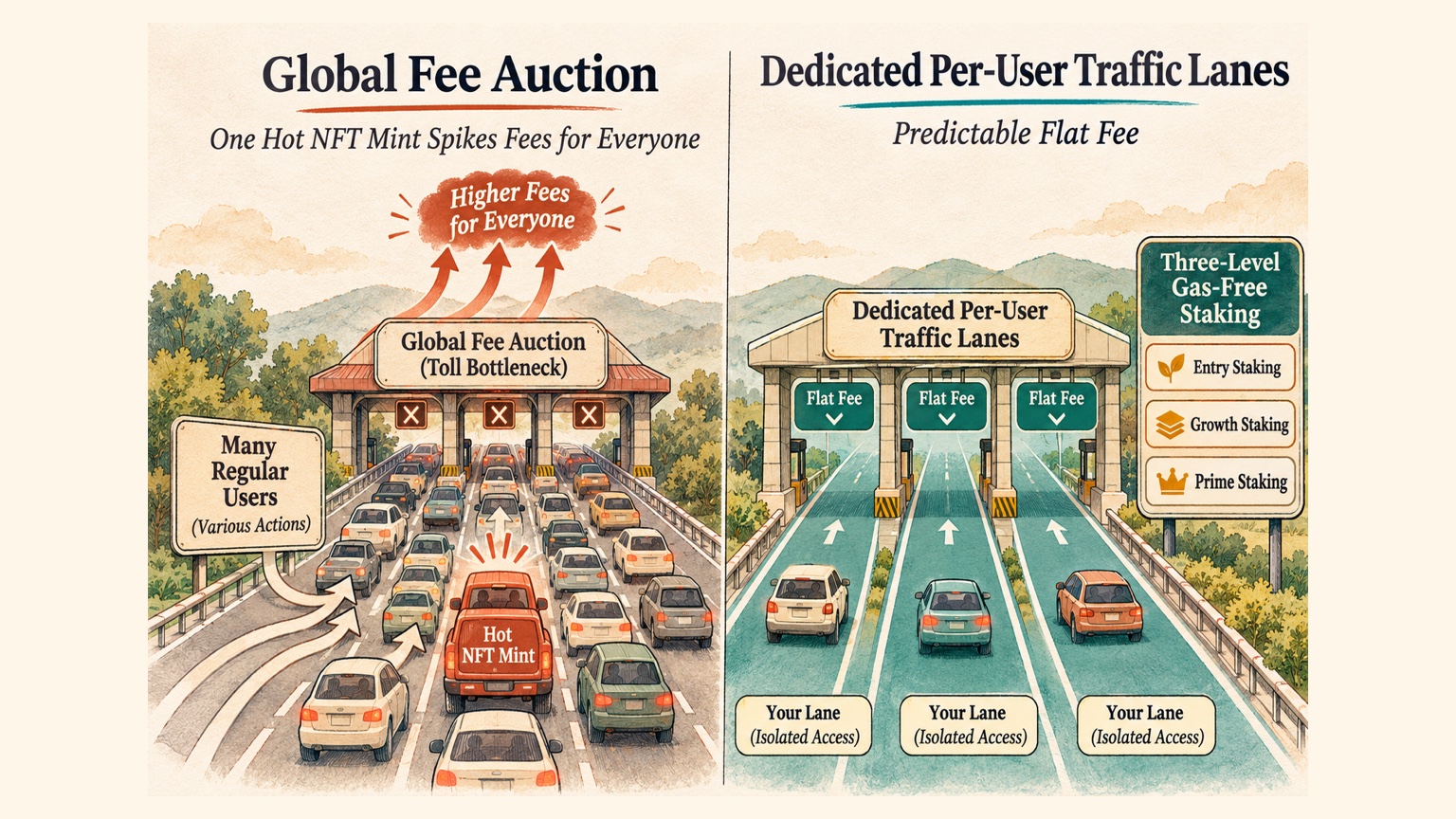
Imagine walking into a grocery store on a Sunday afternoon to buy a three-dollar bottle of water. When you tap your card at the register, the cashier looks at you apologetically and says: "Sorry about this, but the jewelry store next door is having a flash sale on limited-edition gold bars today, and the payment network is jammed, so every grocery store in town is currently charging a fifty-dollar card swipe fee."
In the physical world, anyone would think that is absurd. Yet on most blockchains built around a global fee auction, that exact scenario plays out almost every week. The moment a popular NFT mint kicks off or a handful of arbitrage bots start sweeping pools, the network-wide base fee skyrocketsdozens-fold in seconds. An ordinary user who just wants to send a friend ten dollars, update a DID document, or claim an event badge, having nothing whatsoever to do with the frenzy, is forced to pay a punitive congestion tax for someone else's speculation.
For application builders, the "first drop of water" problem is even worse. A mainstream user downloads a wallet and opens your app with zero native tokens in their account. If you tell them, "Please go register at an exchange, pass KYC, buy a few tokens, withdraw them to cover gas fees, and come back," ninety percent of them will vanish on the spot. Yet the moment a well-meaning team opens an unrestricted "free gas relayer" for newcomers, automated script farms usually drain the sponsorship pool dry within an afternoon.
When designing the fee and admission architecture for ArcBlock and ARC, we decided to fix both problems at the root: first, abolish the global congestion auction where one noisy actor raises prices for everyone, replacing it with independent per-user traffic lanes; second, turn "gas-free transactions" into a safe, composable capability built from three building blocks: Personal Self-Staking, Unlinkable Privacy Gas Passes, and Scoped Merchant Paymasters.
Principle 1: Contain Bursts in the Sender's Own Lane, Never Spike Prices for Innocent Neighbors
Why does a high-frequency bot spamming transactions make life expensive for a quiet human user across the street? Because traditional blockchains only meter the total congestion of the entire highway and raise the toll for every car simultaneously, without ever asking who is causing the traffic jam.
Our philosophy is straightforward: give every verified identity (and every delegation pair) its own independent sliding-window traffic lane, and never dynamically jack up the per-transaction fee based on traffic bursts.
This per-user burst quota model follows three common-sense engineering rules:
- Predictable, flat pricing before you ever click send: Infrastructure costs should be as predictable as a cloud bill. No matter what anyone else is doing on the network right now, the base fee for your transaction remains constant. We never multiply a transaction's price on the fly just because traffic spiked.
- Need a wider highway lane? Stake to expand it instead of bribing the queue: Every basic account enjoys a generous per-minute allowance that comfortably covers human interaction and everyday operations. If you run a high-concurrency business service or settlement node that needs to push hundreds or thousands of transactions per minute, you don't enter a bidding war against other users, you simply increase your
Stake-for-Gasposition, and your account's dedicated lane width scales up linearly. - Stop floods at the front door while giving wallets clear navigation: When an account temporarily bursts above its normal allowance without hitting the hard ceiling, transactions continue to flow while the receipt returns structured guidance telling the wallet or SDK how many milliseconds to back off, or how much additional stake would bring its load ratio back to normal. Only when a runaway script slams into the hard ceiling does the admission gate reject excess packets right at the front door, before they ever enter the ledger write queue.
Principle 2: Gas-Free Doesn't Mean Defenseless, Use a Lightweight Envelope and Graduated Cooldowns
Once every user's traffic sits inside an isolated lane, we can safely open Stake-for-Gas (fee-free transactions backed by staking). Still, an obvious security question remains: if transactions are free to send, what stops an attacker from using the free channel to dump megabytes of binary junk into the ledger or spam malformed requests to exhaust node CPU?
To keep the free channel clean without nagging honest users, we place two automatic guardrails at the admission layer.
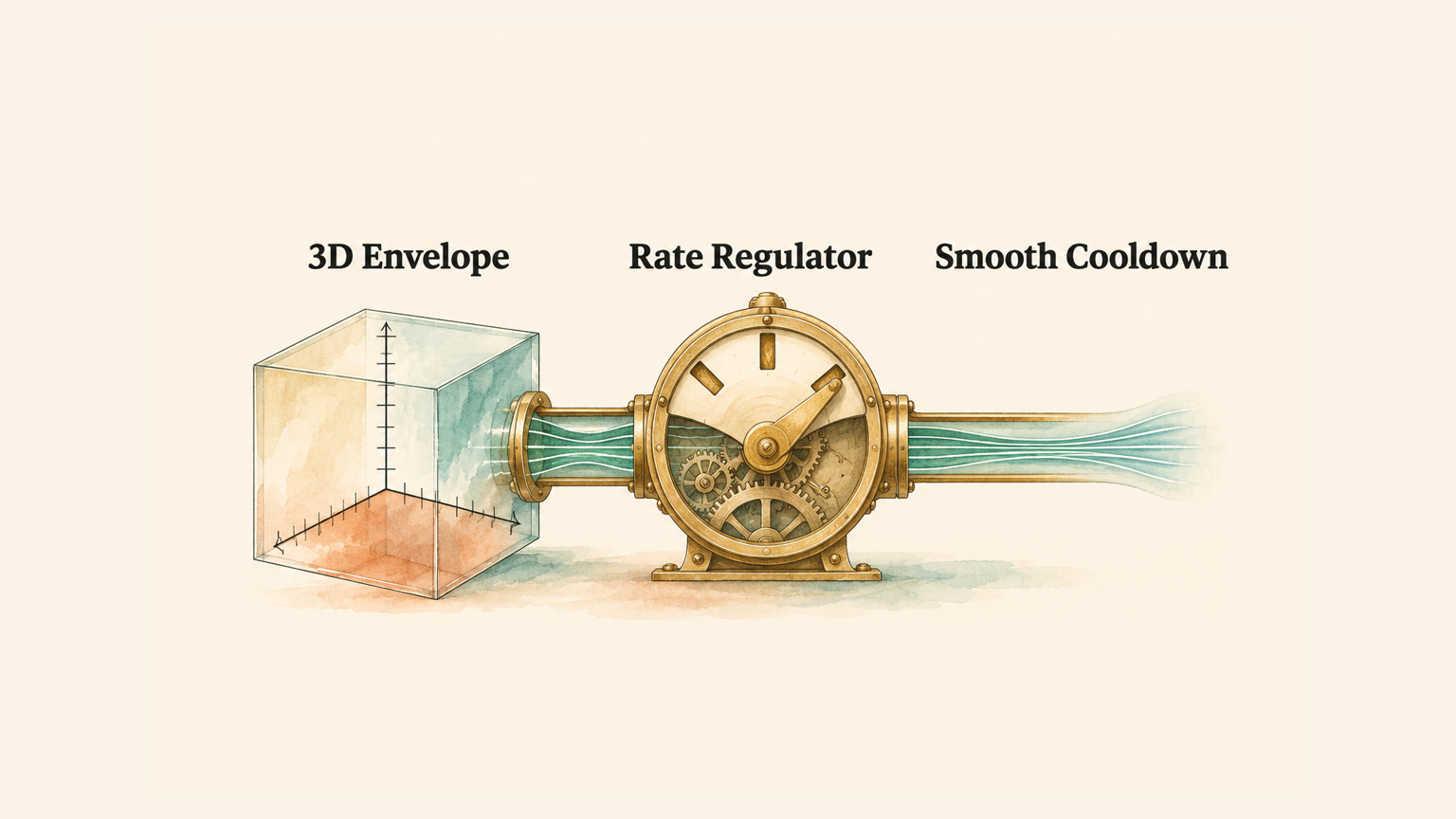
The first guardrail is a Three-Dimensional Lightweight Eligibility Envelope. Not every on-chain action should be free; the protocol checks three simple dimensions:
- Action Type: Everyday high-frequency interactions, transfers, peer-to-peer swaps, claiming and consuming digital assets, identity declarations, account migrations, delegations, and stake management, all qualify for the gas-free lane. Heavy, low-frequency administrative actions that permanently expand global ledger state, such as creating new token factories, minting heavy asset collections, or executing complex multi-op blocks, must pay standard direct fees.
- Payload Size: A gas-free transaction must stay compact (for example, under 4 KB), preventing anyone from stuffing large binary blobs into the verifiable ledger for free.
- State Footprint: A single gas-free transaction may only create or update a bounded number of state entries (such as six or fewer). If a transaction exceeds any of these three bounds, it isn't rudely dropped, it simply falls back to standard pay-per-use settlement.
The second guardrail is a Four-Level Graduated Cooldown that never punishes honest mistakes. In the real world, a mobile user on a spotty connection might accidentally double-tap a button, or submit a transaction when their balance is slightly short. Treating benign user errors as hostile attacks would ruin the experience.
Our security guard strictly separates everyday hiccups from deliberate boundary probing: benign state errors like duplicate clicks, expired timestamps, or insufficient balances carry zero penalty points, no matter how often they happen. Only when a cryptographically verified signer repeatedly triggers security firewall rejections or attempts to violate ledger conservation rules does the system record weighted strikes within a rolling ten-minute window and respond in graduated steps:
| Security Stage | What Triggers This Stage | How the System Responds & Recovers |
|---|---|---|
| Normal Flow | Everyday usage, or benign hiccups like network retries and insufficient balance | Zero penalty points; full access to gas-free exemptions and burst lanes |
| Gentle Warning | Occasional brush against pre-flight security rules or paymaster scope checks | Transaction proceeds normally while returning a diagnostic warning signal to the client |
| Brief Cooldown | Repeatedly hitting security guardrails within a short window | Triggers a brief 15-second admission cooldown; normal access resumes automatically afterward, and points expire after 10 minutes |
| Strict Enforcement | Sustained, high-frequency malicious violations crossing the danger threshold | Enforces extended admission blocking; when automatic slashing is enabled on-chain, the abuser's self-stake can be transferred to the security vault with on-chain evidence |
How Users and Builders Compose the Three Levels of Gas-Free Staking
On top of isolated per-user lanes and graduated guardrails, we packaged gas-free capabilities into three progressive building blocks. Whether you are a regular individual user, a privacy-conscious digital resident, or a startup building a consumer Blocklet app, you can combine them to fit your exact workflow:
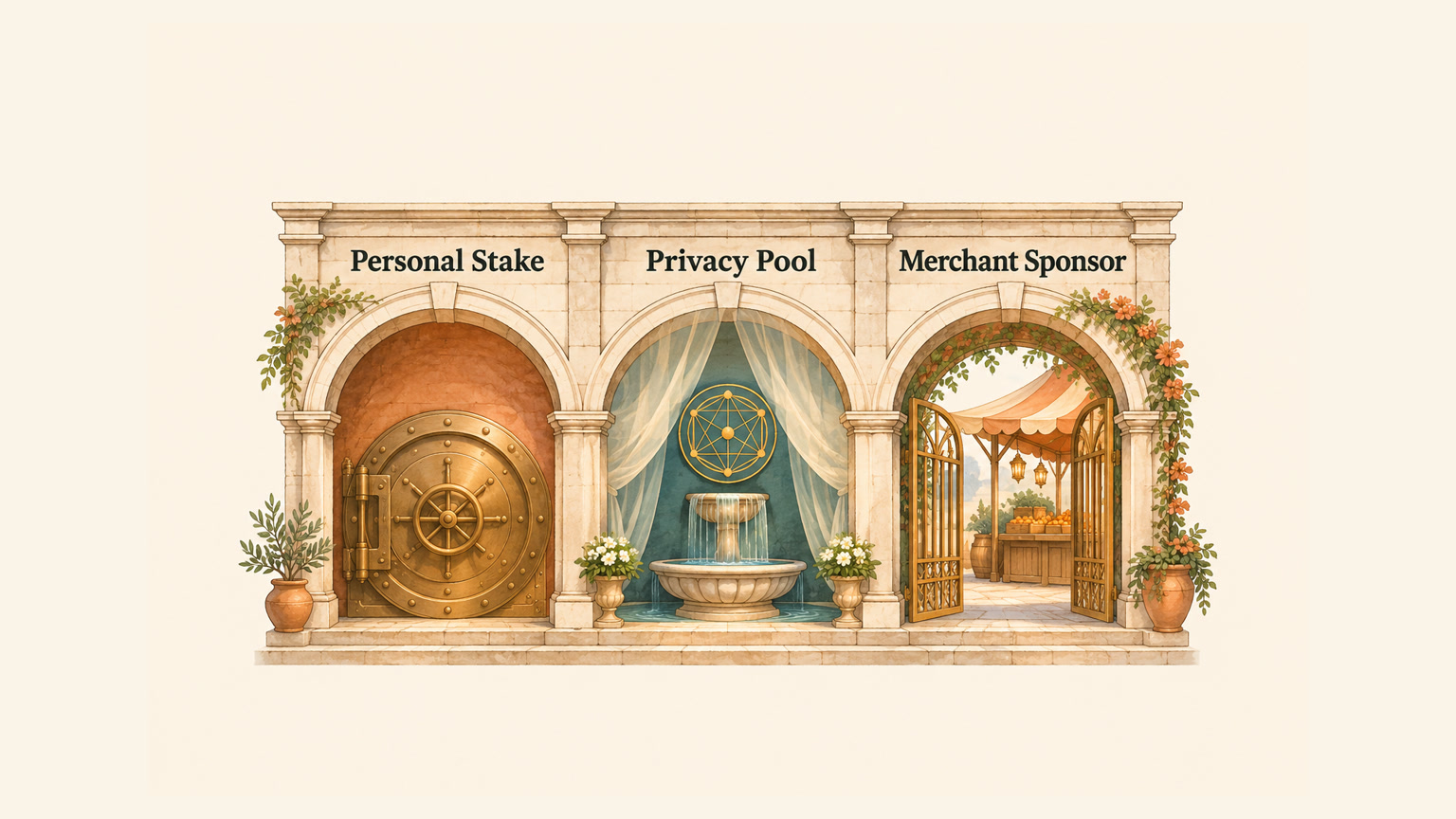
Level 1: Personal Self-Staking (An "Expressway Annual Pass" for Regular Users)
If you regularly send tokens, collect NFTs, manage nodes, or use applications across the ecosystem, the simplest pattern is Personal Self-Staking.
It works like a refundable electronic toll pass: you stake a modest amount of tokens under your own main DID. Those tokens remain 100% yours and can be unstaked and reclaimed in full whenever you choose. For as long as your stake is active, every everyday transaction you make within the lightweight envelope has its fee waived to zero, you never have to worry about keeping loose change in your wallet for gas again.
Level 2: Unlinkable Privacy Gas Passes (An "Anonymous Family Card" for Multi-DID Privacy)
Power users quickly run into a subtler privacy dilemma: to keep different parts of life separate, people naturally create multiple independent sub-DIDs, one for public writing, one for collecting private digital art, another for running a side project.
Staking separately in every single sub-DID ties up too much capital; yet if your main DID directly pays the transaction fees for all five sub-DIDs on-chain, any outside observer can immediately connect the dots: "Aha, these five seemingly unrelated identities are all funded by the same person!"
To solve this, we built the Unlinkable Privacy Gas Pass. You only need to stake once under your main account. From there, your wallet can locally generate single-use, short-lived cryptographic Gas Passes for any of your sub-DIDs. When a sub-DID submits a transaction, it attaches that one-time pass; the ledger verifies the cryptographic commitment against your stake and waives the fee on the spot, without exposing which main identity signed or funded the pass to outside observers. You get the capital efficiency of a single stake while preserving strict privacy boundaries across all your personas.
Level 3: Scoped Merchant & DApp Paymasters (A "Store-Bound Free Shipping Voucher" for Builders)
If you are building a consumer-facing creator community, AI assistant, or storefront, your goal is simple: a brand-new user should be able to click in and use your product immediately, without ever hearing the word "Gas."
That is where the third building block comes in: the Scoped Merchant Paymaster. Unlike first-generation open gas relayers that bots could hijack to run arbitrary transactions across the network, our Scoped Paymaster lets a builder lock fee sponsorship inside three tight business boundaries, just like issuing a free-shipping voucher valid only for items in your own shop:
- Target Address Allowlist: The protocol automatically inspects every address touched by a transaction. Sponsorship only applies if every non-sender target address falls strictly inside your application's signed allowlist. No user can take your free gas sponsorship and use it to call someone else's app or transfer tokens to random wallets.
- Action Type Allowlist: You specify the exact transaction types your business needs to sponsor, such as claiming a membership badge or consuming compute credits, and nothing else.
- Dual Settlement Modes with Per-Transaction Caps: For lightweight interactions, the ledger simply uses your merchant account's
Stake-for-Gasposition to waive the fee at zero marginal cost. And when your workflow involves a heavier transaction that requires direct fee payment, you can switch the voucher to direct paymaster mode with a strict per-transaction ceiling, paying cleanly out of your dedicated sponsor balance.
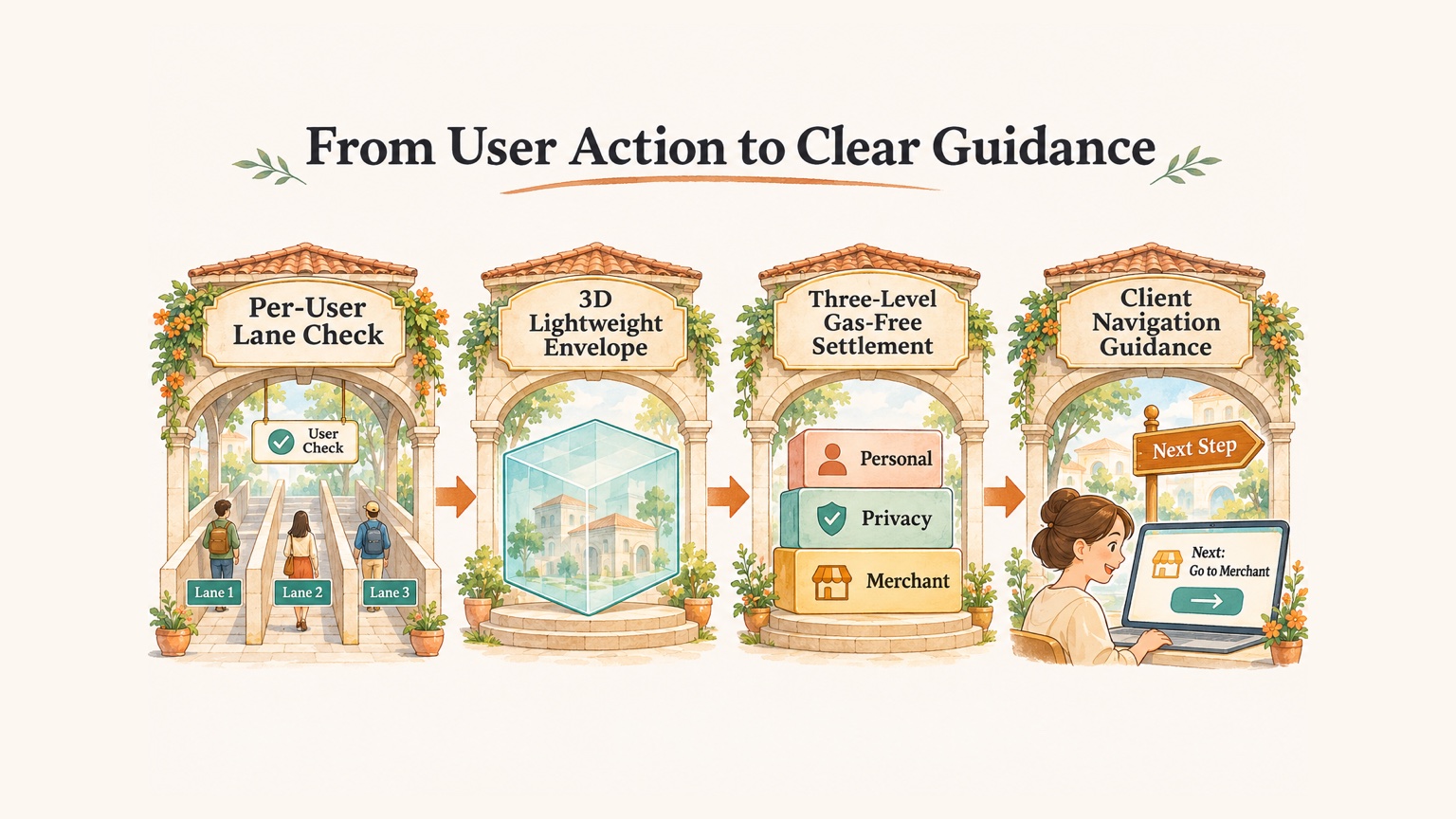
Thinking back to the grocery store joke at the start of this post, charging fifty dollars to swipe a card for a bottle of water because the jewelry store next door is selling gold bars, our entire goal in redesigning admission and fee sponsorship was to bring common sense back to blockchain engineering: keep every user's traffic in their own lane, make everyday interactions free and frictionless, and reserve hard boundaries strictly for abusive bots. When builders snap Personal Self-Staking, Unlinkable Gas Passes, and Scoped Paymasters together, the underlying blockchain finally disappears into the background, leaving users with an application that feels as effortless as tapping a transit card.