Aside: Turn sharing back toward your own place

We have released Aside. It begins with a small action on iPhone: when you find something worth keeping, tap Share and save it into a place of your own.
That sounds like a bookmark. It also sounds like a note. This is not a new problem. The question we never solved well was not how to save a link. It was who owns what comes next, what survives when a service disappears, and whether scattered saves can gradually become something of your own.
Aside is our new answer to that old problem. It is also the first ARC mobile product made for everyday consumers. The first release starts on iOS and is available on the App Store.
Good tools disappear. Your data should not disappear with them.
Over the years, I also explored versions of this idea through KnowledgePoint, NeoPapr, Personal Site Framework, Slicel, CrossCourse and Mood Journal. The names and dates are not important. They only show that I kept encountering the same ordinary problem as many other people: find a tool you love, carefully put years of material into it, then discover that the product's lifetime never belonged to its users.
We have never lacked excellent tools for bookmarking, reading later and managing personal knowledge. Some defined an era and taught millions of people to keep part of their lives online. But when a company changes direction, a product changes hands or a service closes, users discover that “my collection” and “a collection I can continue to use” are not the same thing.
| Product | What it once made possible | What users eventually faced |
|---|---|---|
| del.icio.us | Turned bookmarking, tagging and sharing into an everyday Web 2.0 habit | After several ownership changes, it stopped accepting new bookmarks in 2017; a living knowledge network became read-only history |
| Bloglines | Brought RSS subscriptions scattered across the Web into one reader | After a planned shutdown and a transfer to a new owner, the original service eventually disappeared; users could take OPML, but not the reading space around it |
| Google Reader | Made subscribing, reading and sharing a central way to experience the Web | Google retired it in 2013; subscriptions could be exported, but years of reading habits and social context did not move with them |
| Made “read it later” work across devices and kept a personal reading list | Mozilla shut it down in 2025; users had to export before a deadline, after which accounts and data were deleted | |
| Evernote (still operating) | Brought notes, Web pages and reference material into a long-lived personal archive | The product remains, but ownership and pricing can change; the operator still decides how easily old material can be recovered and used |
These products had very different businesses and histories. It would be too simple to call them one kind of failure. Closing a product may also be a rational and difficult decision for its operator. From the user's side, however, the common problem is clear: whether a good product can continue operating should not decide whether a person's memories remain usable.
An export is better than losing everything. But an XML, JSON or OPML file is an emergency exit, not a personal space that still lets someone read, organize, connect and publish. People should not have to rescue their history once a product announces its shutdown. They should control its continuity from the beginning.
The cloud is not the problem. People need something that is always on and remains available after changing devices. The question is whether we can keep that convenience without giving one operator control over the fate of the data.
Reverse the direction of Share
In 2026, the immediate trigger for Aside was the most ordinary menu on a phone: the system Share Sheet.
Tap Share today and the direction is almost always outward, sending something into another platform. I wanted to reverse it: Share can also mean saving something into your own place.
The first loop became simple: collect, organize and publish.
First, keep a link, a piece of text, a photo or a file, much like “read later.” Then put related material together and leave your own notes. If you choose, the public part can eventually become a personal site that other people can read. You do not need to start with the grand intention of building a website. A site can grow out of the things you already collect every day.
The internal first version was called Stash: keep something first, decide what to show later. The public name became Aside. In English, an aside is something added almost casually to a conversation. The name fits. A small thing shared in passing might eventually become part of your site.
Aside also has a beaver mascot named Timber. This is a consumer app, and we wanted it to feel like something people would enjoy opening every day, rather than another serious enterprise console. A beaver also fits the product. It collects material and gradually builds those scattered pieces into a place of its own.
There is a small Easter egg in the name: Aside Beaver Timber gives us the initials ABT. We took the naming seriously, but not so seriously that we couldn't have a little fun with it 🤣
Aside Beaver Timber, or ABT.
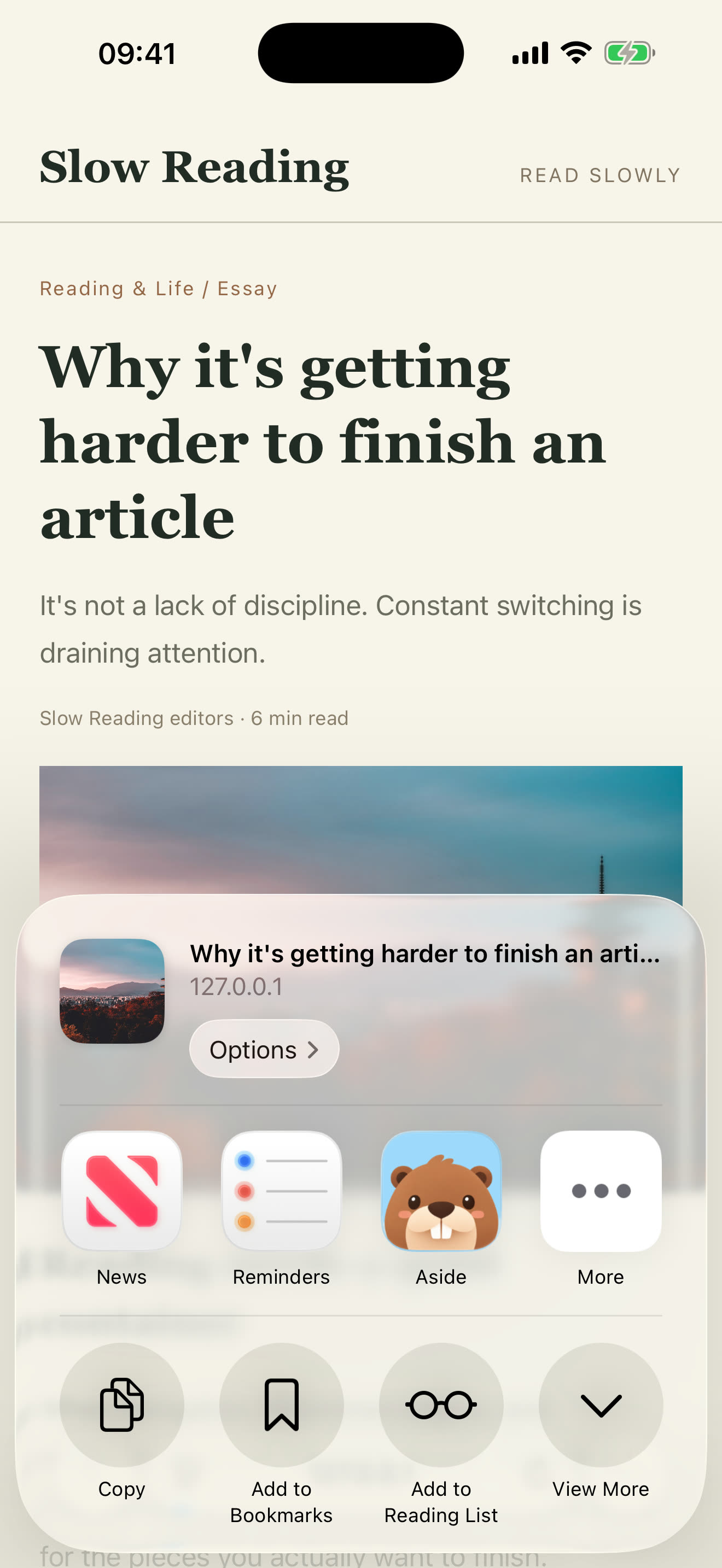
The current Aside iOS interface, captured from aside.sh in September 2026.
A save should not be the end
Many collection products fall into the same loop: save, accumulate, feel guilty, abandon.
Aside is built around a different loop: collect, organize, publish, then discover something new through what other people have organized.
That is why it is more than another bookmark manager. A link can stay beside the note that explains why you kept it. Photos, places and references can become a trip. Pages and questions around one subject can gradually become a research collection. Organizing is not only adding tags. It leaves room for your judgment.
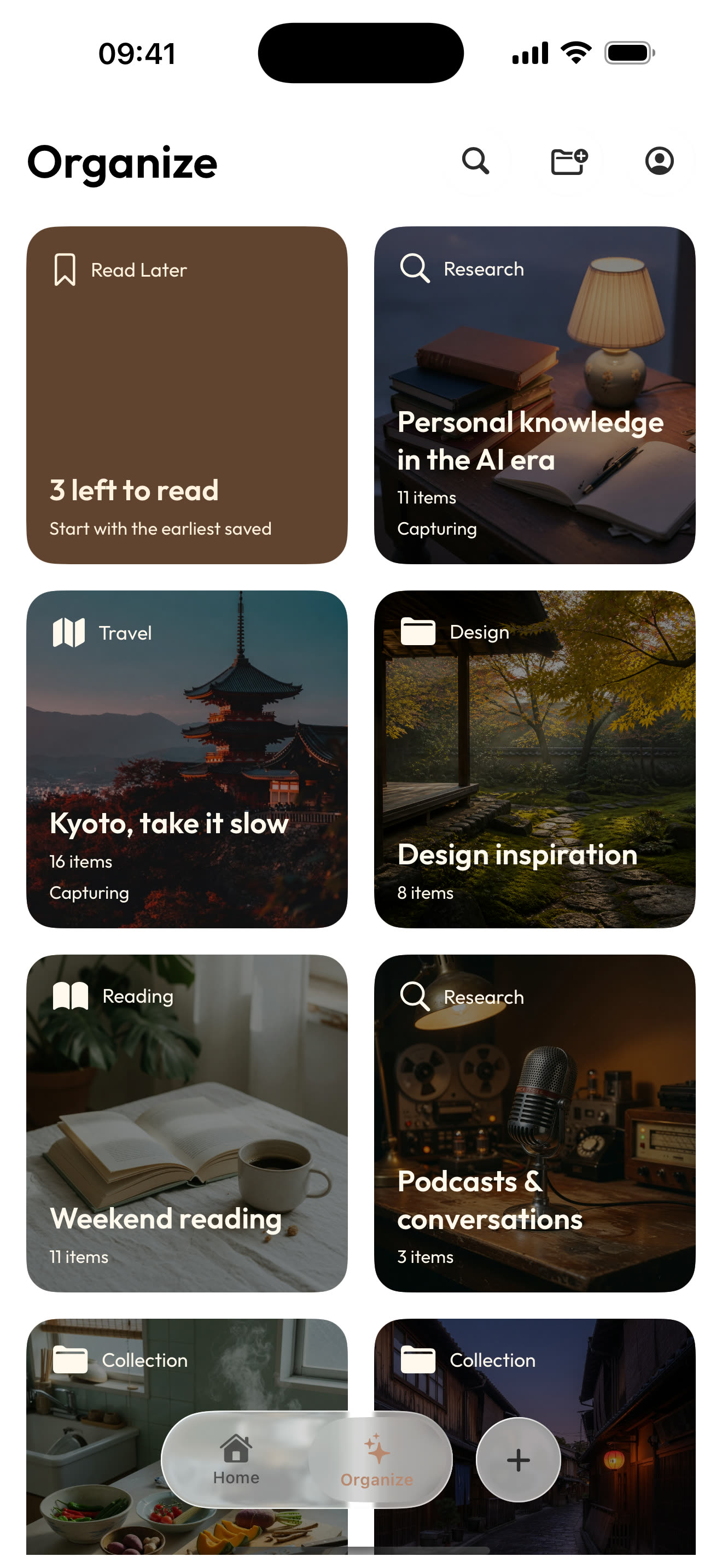
Aside's collections interface. Sharing and discovery are planned; the current release focuses on local collection and organization.
Publishing can create a response, and that response can make collecting feel worthwhile again. But the order matters. It begins as your material and only then becomes public or connected. We are not building a content platform by quietly turning personal libraries into the platform's data pool.
What “belongs to the user” has to mean
Data sovereignty can easily become a correct but empty phrase. In Aside, it has to show up in concrete choices.
The iOS version available today works without signing in, with its Local Library stored on the user's device. The user decides what to collect, how to organize it and what stays private. Remote pages and previews may still require a network connection. Saving a link does not mean downloading an entire website. Those boundaries need to be explicit.
Next, Aside will connect to ArcSpace, previously known as DID Space. The goal is not to replace local storage with our cloud. It is to let a user-controlled data space remain always on and synchronize across that user's devices. Sync will remain optional. Self-hosting, local-first use and cloud availability should not have to exclude one another.
This is also why it was difficult to complete the idea earlier. Bookmarks alone are not enough. Cloud sync alone returns to the platform-account problem. Local files alone are too much work for most people. DID gives the space an identity controlled by the user. ArcSpace gives the data a continuously accessible place. Aside can then be an application on top, rather than another data island.
The first release does not yet provide cross-device sync or a way to publish collections as public sites. Android, Web, browser extension and desktop versions are also later steps. We will release them one by one instead of writing future tense as present tense.
ARC goes into a pocket
Aside has another meaning for ArcBlock.
The new ArcBlock website runs entirely on ARC, the Agentic Realm Computer. ArcBlock Community has also completed its move from the Discuss Kit application running on Blocklet Server to ARC. Together, they show that ARC can serve websites and continuously changing community content.
Aside tests the system from the other direction. Can an everyday consumer app, held in someone's hand, also be built on ARC?
We deliberately run the Aside team like an independent third-party application team. They focus on Aside and do not implement the ARC core. When the platform gets in their way, they bring a real product problem back to us. The developer responsible for the first iOS release had Android and Web experience, but had not previously delivered a complete iOS product. With ARC and AI coding agents, he took the product all the way to the App Store.
That does not prove that anyone can make a good app with one sentence. Product judgment, debugging, design and release work have not disappeared. It demonstrates something more practical: prior platform experience is no longer an impassable gate. A developer with a product idea can use agents and a stable application foundation to extend into an unfamiliar device platform.
For ARC, that is much more useful than another technical demo.
This is the first article
This article only tries to answer two questions: what Aside is, and why we are building it now.
We will follow with how to use it, what its developer learned while delivering a complete iOS product for the first time, how ArcSpace sync preserves user control, and how mobile, Web, desktop and browser extensions can share the same application capabilities. Aside will keep shipping, and this series will move with the product.
The thing I kept thinking about for twenty years was never really the shape of a bookmark. The question was what happens to everything a person left behind when a product stops continuing.
Aside's answer begins with one small action. The next time you find something worth keeping, tap Share and send it back to your own place.
Referenced here
Products
-
ARC
active
The runtime for Blocklets. It gives a developer a place to run an application described as a Blocklet, together with the resources that Blocklet declares it needs.
-
ARC Space
active
A data space associated with a DID. Create a personal space, or connect an application with the permissions and data model its task requires.
-
Aside
preview
Collect the things that catch your attention and revisit them in collections.
Terms
-
AFS
AFS (Agentic File System) turns the files, services, and active work relevant to a task into an inspectable resource view. Instead of handing an agent an undifferentiated machine or a pile of APIs, it gives the task a world with names and boundaries.
-
AUP
AUP (Agentic UI Protocol) lets an application express what is shown and what actions are available. A runtime then renders the parts that fit its device capabilities, instead of treating one screen's pixels as the application itself.
-
DID
A DID is a digital identifier. It helps its holder and a verifier establish who controls an identity and who a claim relates to. It is not a wallet, and it does not replace application accounts, sign-in methods, or permission rules.