Free 30-day Trial of DID Domain!
In order to help users test and explore the ArcBlock platform at a lower cost, unleash their creativity, and build their own applications, DID Domain has launched a free trial domain service.
Free Trial
Statement
- The trial policy introduced this time is the policy at the time of blog publication, and does not mean it will never change.
- ArcBlock reserves the right to adjust or terminate the trial policy based on actual usage, and the termination will not affect domains that have already been purchased or hosted.
Free policy
- You must pay using ABT.
- You need to stake 1 ABT.
- Each top-level domain is limited to one free trial per user.
- Each user can try up to 1 hosted domain for free.
- The free trial period is 30 days.
- After the trial period expires, you will be automatically billed at the price set when subscribing or hosting the domain.
Example
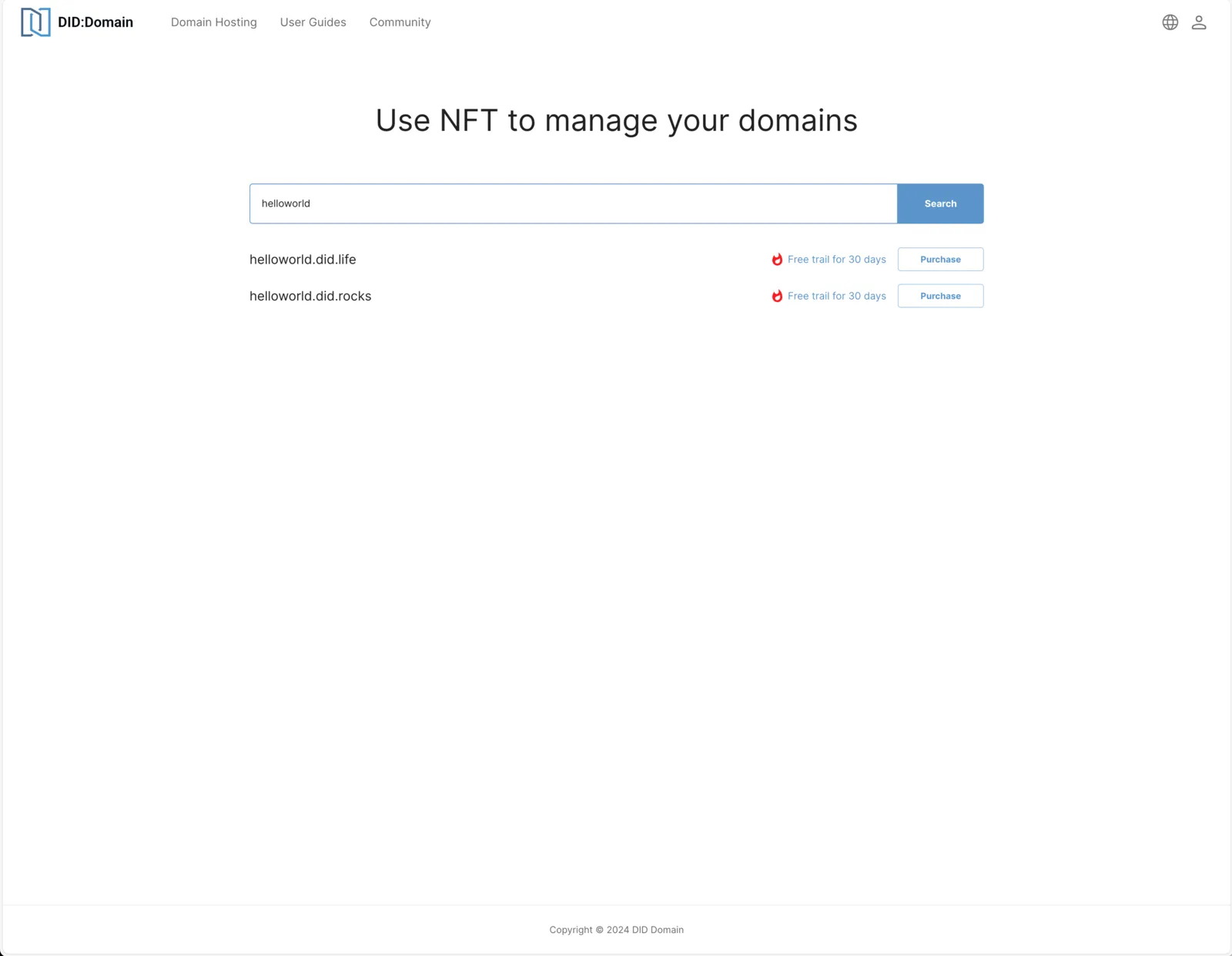
The top-level domain names currently on sale are two: did.life, did.rocks. According to our free policy, each top-level domain name can be tried for free by each user at most once, and each user can try at most one hosting domain name for free; that is, users have three free trial domain names; for example:
- helloworld.did.life
- helloworld.did.rocks
- A hosted domain
Help us improve together
If you have any needs, suggestions, or problems during the use, welcome to visit ArcBlock Community to provide feedback. We will do our best to help. In addition, if your feedback is selected for our Bug Bounty Program, you will receive ABT rewards.
Referenced here
Products
-
DID Names
active
Domain management built on DID and verifiable credentials. One account can host and manage many domains at once, rather than configuring each one separately.
Terms
-
Decentralized Identity
An approach where the identifier and the claims about it are held by the subject and checked by the verifier, instead of living inside one provider's account system. DID and verifiable credentials are the pieces that make it workable.
-
DID
A DID is a digital identifier. It helps its holder and a verifier establish who controls an identity and who a claim relates to. It is not a wallet, and it does not replace application accounts, sign-in methods, or permission rules.
-
Self-Sovereign Identity
The position that a person should hold their own identifiers and credentials and decide each time what to disclose. It is a stance about who is in control, not a protocol; decentralized identity is how it gets built.