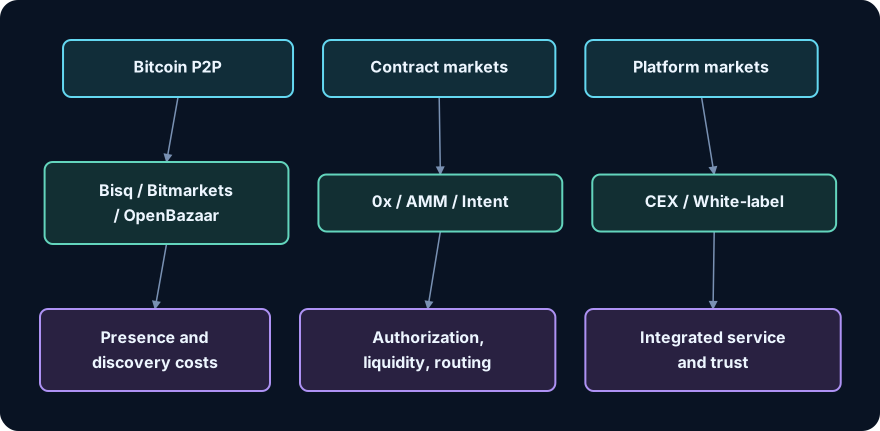
Why markets concentrate, and what P2P must solve
Alice has a camera and wants a lens. Bob has the lens. Both are honest, both want to trade, and both have working payment tools. Nothing happens, because they do not know each other exists.
That is the market problem before it becomes a settlement problem. Barter is a useful thought experiment here, not a claim that every society followed one historical sequence from barter to money to exchanges. Credit, gifts, obligations and direct exchange have coexisted in different arrangements.
What an intermediary actually sells
A camera shop might buy Alice's camera and wait for another buyer. It supplies inventory and absorbs waiting time. A broker might introduce the parties without owning either object. A marketplace makes offers comparable. These are different services, even when one business provides all three.
Coase's argument about the cost of using the price mechanism helps explain why coordination can move inside an organization. It does not establish a universal history of exchanges, or imply that technology eventually makes every intermediary unnecessary. It gives us a useful question: which costs are lower inside this organization, and which could be lower outside it? The Nature of the Firm, 1937
A market must make participants discoverable, communicate terms, establish enough confidence to proceed, and coordinate delivery. Liquidity matters too: finding someone who might eventually want your camera is different from finding someone ready to buy now. The compensation an intermediary earns can reflect real work and real risk.
Online, visible and executable are different
An endpoint can be reachable while its quote is stale. A listing can survive in replicas while its seller is unavailable. A signed offer can be valid while the assets have already been committed elsewhere.
A working market needs presence, freshness, cancellation and a clear definition of commitment. If every search returns attractive but unavailable offers, discovery has failed even if the network delivered every message correctly.
Searching also involves more than locating bytes. Natural language, incomplete preferences, counterfeit claims and spam need handling. Someone must pay for storage, indexing and abuse resistance. Decentralization changes who can provide these services; it does not remove their operating costs.
A thousand independent nodes need not contain a willing counterparty at the desired time and size. Fragmented inventory can make execution expensive. Capital requirements and multiple signing steps may compound that problem.
AMMs offer one response by committing inventory to a shared pricing mechanism. RFQ networks offer another by asking professional liquidity providers for executable terms. A personal agent should be able to use both rather than treating direct P2P as a moral requirement.
Fiat and physical delivery introduce another boundary. If one leg can be reversed, contested or observed only by a bank, simultaneous movement of blockchain assets does not settle the whole economic transaction.
Follow the dependencies
| Layer | Question worth asking |
|---|---|
| Custody | Who can move the assets, including through approvals or admin powers? |
| Presence | Can the participant remain reachable independently of one website? |
| Publishing | Who can publish, expire and withdraw an offer? |
| Discovery | Can users substitute an indexer or ranking system? |
| Negotiation | Whose preferences and incentives define acceptable terms? |
| Routing | Who sees the intent and chooses the execution path? |
| Settlement | Which rules enforce authorization and asset movement? |
No single answer establishes the whole system's character. A permissionless contract behind a dominant website retains genuine value: alternative access remains possible. Whether alternative access is practical, discoverable and affordable is another question.
A persistent endpoint should be able to receive messages without automatically spending money. An indexer should help find offers without owning all the underlying relationships. An agent should evaluate proposals without treating a counterparty's instructions as authorization.
These separations make useful specialization possible. We do not need to eliminate indexers, brokers or market makers. We need to avoid making any one of them the inseparable owner of the user's identity, context and execution authority.
Could agents change the economics?
A person cannot efficiently negotiate with hundreds of potential counterparties while tracking deadlines and comparing every combination of price, delay and privacy. Software can automate much of that work. AI may broaden the range of preferences and conversations it can handle.
But inference, messaging, verification and failed negotiation still cost something. Agents can also amplify spam, converge on the same strategy or rely on the same centralized provider. The comparison should measure total costs under the same authorization and risk constraints, and include a simple fixed-rule program as a baseline.
The promising hypothesis is narrower: persistent personal infrastructure plus bounded agents may make some formerly expensive coordination practical outside a single exchange. If it does, intermediaries can compete with that option by offering better service. If it does not, the architecture should tell us where the economics failed.
For custody, matching and operating boundaries, see CEXs and white-label exchanges. Different DEX designs compare how protocols take on these costs.