AIGNE v0.4.20: Supports Agent cache, Scheduled Tasks, and Streaming Responses
In the past two weeks, we actively listened to and responded to user feedback, continuously optimizing the functions of AIGNE through rapid iteration. Today, we have released v0.4.20. This new version introduces an enhanced Agent cache feature, supports scheduled task functions, and adds streaming responses, providing developers and users with more powerful tools. These new features not only greatly assist Agent developers but also significantly enhance the user experience. Next, let us delve into these exciting updates together and explore the new possibilities brought by the latest version:
New Feature
Agent Cache
According to the input data, run and cache the output of the Agent. When you run an Agent, if there is previous data with the same input, the system will prioritize using the result of the previous run. If there is no same input data, the Agent will run directly and cache the output result for next time use to get results faster when using the same input.
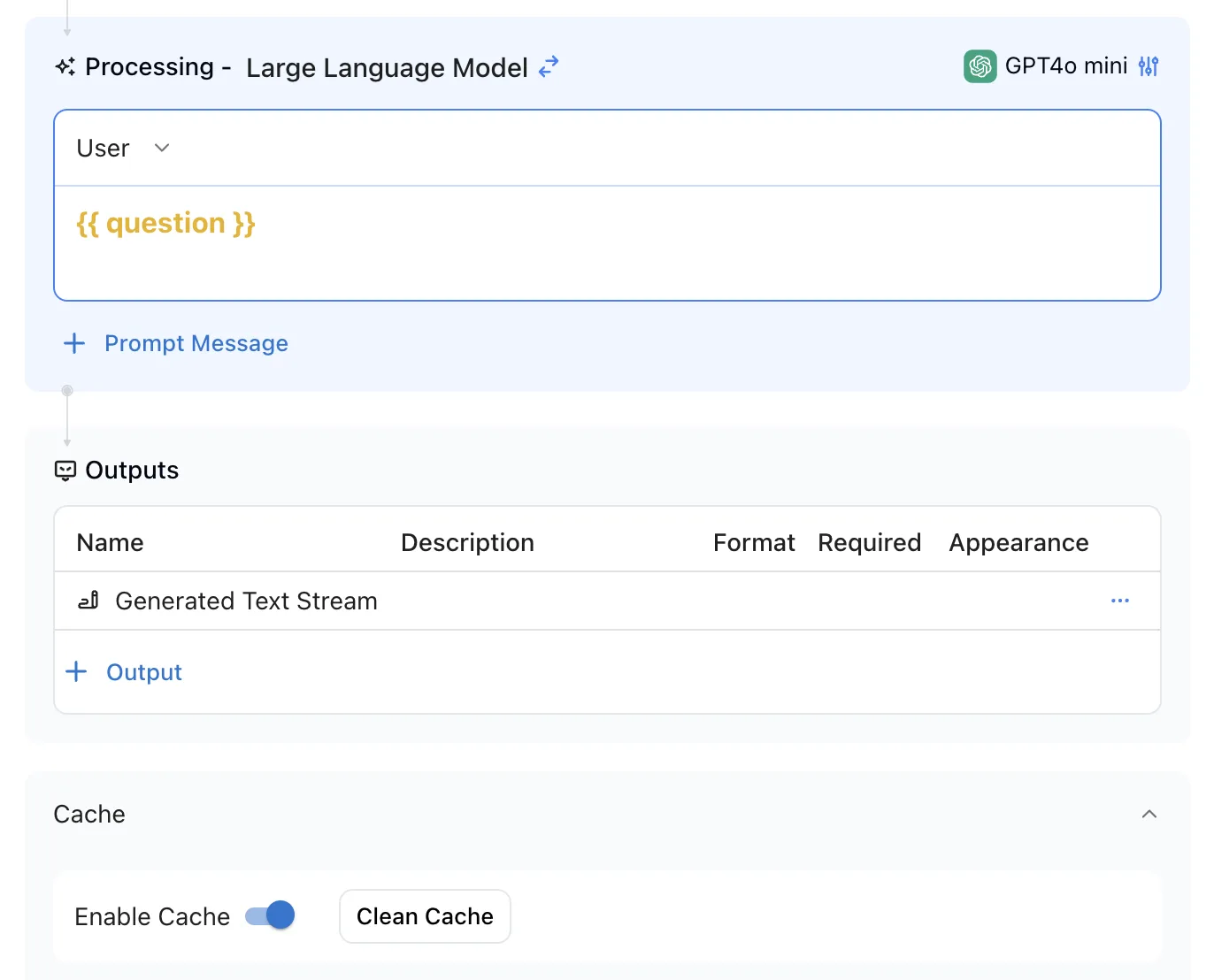
- Enable caching: Enable caching optimization for Agent, prioritize using cached data for the same input
- Clear cache: Clear all data cached by the current Agent.
Scheduled to run Agent
Set a running cycle for the Agent to run automatically. This feature can help users achieve functions such as scheduling tweets and automatically writing blogs.
Support viewing the running history of Agent scheduled tasks.
Stream response
Streamed responses can return prepared output data as soon as possible, allowing clients to display data earlier and thus improve user experience.
In the Mockplexity application, data will be returned and displayed to users in three stages:
- Return user input questions
- Return search engine query results
- The answer given by AI
This phased response mechanism ensures that users can see preliminary results more quickly, greatly improving the interactive experience.
Other Improvements
- System prompt optimization: In this version, we have optimized and updated the system prompts, so you can now get output results that better match the user's intent 🚀
- Hidden input: In the previous version, we supported hiding the output based on community feedback for easier debugging. Now, we also support hiding the input 🫥
- Upload project icon: We have optimized the user experience of uploading project icons. Now, you can click on the project icon to upload new images directly ⏫
We listen to your voice with our hearts: community-driven updates
We believe that the core of our product lies in a vibrant user community. Your insights and suggestions are extremely valuable to us, and we are committed to incorporating your feedback to make AIGNE even better. In this release, we focus on the latest updates and bug fixes inspired by you (our users). From minor adjustments to major changes, each update is a step towards enhancing your experience and meeting your needs. Thank you for your continued support and involvement. Let's see how your feedback has helped us improve what's in this version!
- Aigne 502 bad gateway z1dTAX6BubAxmhXGP8zMVAZAFwizvbv8gnB
- aigne发布blocklet流程一些体验问题 z1fXXRA3YQTAAkKr4kVTJ6nWZnQm6AFAuNF
- AIGNE doesn’t recognize input variable z1dTAX6BubAxmhXGP8zMVAZAFwizvbv8gnB
- aigne修改项目名称不生效 z1fXXRA3YQTAAkKr4kVTJ6nWZnQm6AFAuNF
- AIGNE X share button not showing up z1dTAX6BubAxmhXGP8zMVAZAFwizvbv8gnB
- Aigne feature - allow no project description z1dTAX6BubAxmhXGP8zMVAZAFwizvbv8gnB
Help us improve 🌟
We hope you have a better user experience in the new version of AIGNE!🚀
Sincere thanks to all users for their attention and support. We will continuously improve to meet your needs better. If you have any needs, suggestions, or problems during use, please provide feedback in the community, and we will do our best to help. 💬
Referenced here
Products
-
AIGNE
active
A framework for developers building agents. Start from the command line to create and run a project; use the framework documentation for the parts that need detail.
-
AIGNE Studio
sunset
A place to build and run agents without writing the wiring by hand, including self-hosted models. Its work has been taken into ARC.
Terms
-
Agent
A useful system can distinguish the person, service, or agent taking an action; the party it represents; and the permission for that action. Treating all three as one shared secret makes a later decision harder to explain.