
Author: Robert Mao, Founder & CEO
(Disclaimer: This article only represents the personal views of the author.)
Recently, a video of Sam Altman, the CEO of Open AI, has become extremely popular on social media. In the video, he mentioned that in the near future, there will be companies consisting of just 10 employees, yet valued at a billion dollars. He further expressed his belief that even a company run by a single individual could be worth 1 billion dollars!
I completely agree with this, and I have evidence to support the belief that individuals who accomplish these objectives are likely to utilize platforms and tools such as ArcBlock or similar ones. This is not an attempt to shamelessly promote for ArcBlock, but a genuine thought based on fundamental principles. These upcoming companies, regardless of their size, whether they have 10 employees or just 1, are not actually battling alone, but benefiting from the knowledge and achievements of those who came before them.
I write this article here to elaborate on and tell you that I believe after reading it, you might not only believe in this possibility, but also discover: the people in these companies are not greedy capitalists, but people who better utilize technology, share benefits, and fulfill social responsibilities. Perhaps this is the decentralized future, as well as the future of AI, and it is also the place where different technologies converge in an era.
Starting from first principles#
The way of thinking in first principles is to view the world from a physical perspective, which means peeling away the superficial appearances of things and seeing their essence, and then moving up from the essence layer by layer. Why can today's technology companies be created and operated by fewer and fewer people, and even potentially be successful with just one person creating a high-value enterprise?
An enterprise often needs various aspects to provide comprehensive services. In fact, from the perspective of first principles, it is not really possible for just one person to complete all tasks, even with strong AI assisting them. The real key lies in 'division of labor' and 'collaboration'.
If I can see further than others, it is because I am standing on the shoulders of giants.
-- Isaac Newton
Scientists often compare themselves to children standing on the shoulders of giants. They are able to see further and higher not only because of their own abilities, but more importantly because of the foundation laid by these giants. The development and progress of computer science have always been driven by these giants standing on the shoulders of other giants in a hierarchical manner. Behind every technology we use today, there are countless people's efforts and support.
The revolutionary improvement of computer technology and internet technology in enhancing the productivity of all mankind needs no further explanation. We do not need to compare the time without computers and the time without the internet, and how much manpower and resources would be needed to accomplish the tasks readily available today. Let us just take a look at the key technologies that have emerged in the past 20 years and how they can improve efficiency and liberate human resources.
Cloud computing technology
Cloud computing is a typical technology that significantly reduces system costs, maintenance costs, and personnel requirements. Before the emergence of cloud services, almost every enterprise needed to maintain a large amount of manpower and resources to operate its own data centers. Cloud computing is equivalent to "outsourcing" these data centers to some extent, from equipment to network to personnel. Enterprises only need a few people to manage tasks that used to require a team of dozens of people. A typical example is Instagram, which had only 13 employees serving approximately 27 million users when it was acquired by Facebook for $1 billion.
Pre-cloud computing | Cloud Computing | Decentralized Cloud /Sky Computing | |
|---|---|---|---|
System Complexity | Very Complex | Complex | Simple |
System Cost | High | Low | Even lower |
Employees Requirements | High Multiple specialized teams such as system administrators and network engineers are needed. | Low Few employees required | Very low Very few or even no dedicated employee required |
Human Cost | High Often requires dedicated personnel for 24x7 management. | Low Usually only need DevOps. | Near 0 Fully automatic, no need for specialized personnel management. |
Decentralized cloud computing services of the future, because they deploy services using decentralized mechanisms and use Sky Computing technology to standardize software modules through abstract cloud layers, resulting in lower deployment and management costs than traditional cloud computing. It is anticipated that users will hardly require dedicated personnel.
The progress of these technologies has resulted in reduced costs and decreased personnel requirements. On one hand, it is the result of high automation; on the other hand, it is equivalent to outsourcing necessary personnel to service providers, allowing the company to only pay for the services without having to hire employees. This is a win-win model, where the company's income is more efficiently distributed to the upstream of the supply chain.
Blockchain
Blockchain reduces the cost of trust and eliminates the need for intermediaries in many fee-related businesses.
Before Blockchain | With Blockchain Technology | |
|---|---|---|
Payment | Complex and expensive. Through banks, credit cards, third-party payment services, etc. Usually requires intermediaries to handle, requiring additional intermediary fees. | Simple, cheap, safe Payment system using blockchain technology No intermediaries, extremely low or even zero fees |
Ledgers | The enterprise needs its own bookkeeping information. These books often vary with different systems and services. Additional expenses are required for data security, preservation, etc. | Blockchain is a distributed ledger service The ledger of blockchain is highly unified, secure, and tamper-proof |
Billing System | If billing is required, it often needs specific software to complete, or different businesses have their own billing management systems. | Systems based on blockchain often come with comprehensive billing management and maintain a high level of consistency. |
Accounting & Finance System | We need a specialized financial and accounting system. The data is often distributed among different businesses and needs to be imported and reconciled. | It can directly connect with the blockchain ledger, fully automated and accurate. |
Although blockchain technology has been around for many years, the actual business applications of blockchain are still very limited up to now. However, it can be foreseen that when blockchain technology is deployed in business systems, it will greatly improve personnel efficiency and reduce the demand for human resources in enterprises. It is possible that a company's payments, billing, and financial management can be operated without any dedicated personnel but still meet operational requirements.
On the one hand, blockchain technology improves efficiency and security; on the other hand, because of trust and security mechanisms, companies can easily 'outsource' all these core key tasks to other companies.
Generative AI and large language models
Generative AI and large language models can greatly reduce the demand for personnel in the following positions (including but not limited to), some of which can even be done without full-time employees:
- Programmers/Software Engineers
- Designer/Graphic Designer
- Copywriter
- Content Creator
- Social Media Personnel
- Marketing Planner
- Human Resources Personnel
What enterprises truly need is only a small number of core individuals. For certain businesses, especially in the early stages or even for a considerable period of time, they only require the founders to provide services based on AI technology. For example, the well-known AIGC company, according to reports, had only 11 full-time employees, including its founder, when it achieved over $100 million in revenue.
Future enterprises may allocate benefits more effectively.#
From the analysis above, we can see that a common feature of these technologies is: although they reduce the demand for people, they all 'stand' on the 'shoulders' of others. In other words, although these companies no longer need to employ many people, their benefits have been distributed to the upstream of the supply chain, and the upstream supply chain also has such a structure, and the benefits are passed down layer by layer.
From a certain perspective, this may be a better way of distributing benefits than hiring employees, which may become a new form of corporate organization in the future.
What has ArcBlock brought to builders?#
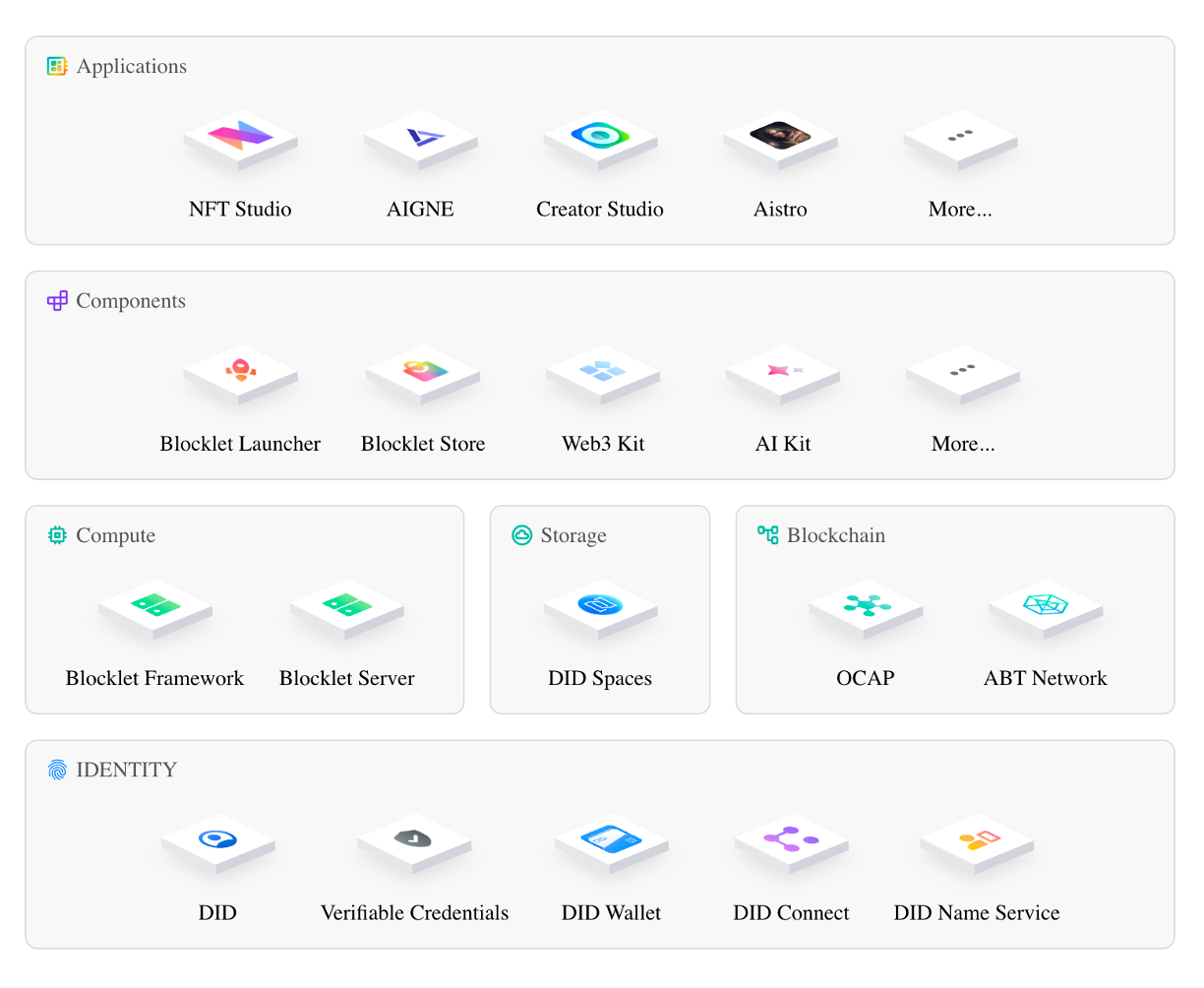
The core of ArcBlock's architecture is a new generation of cloud computing based on the blockchain system, and we have taken the reusability and composability of software modules to a whole new level. Through blockchain and smart contracts, we aim to establish a trustless cooperative relationship among builders, allowing everyone to focus on what they do best and create value together for end users.
Such platforms and architectures maximize support for organizations that are composed of very few people but can provide powerful products and services. In such architectures, a complex service is actually completed by many individuals and organizations, but they do not need to be part of the same organization in order to collaborate efficiently.
Famous investment incubator Y Combinator just released a list of the 100 AI startup companies they have invested in, and 50% of the companies have less than 5 employees! In fact, 26 of these companies have only two people, which are the founders themselves. This trend is quite apparent.
We will launch a series of demonstrations, training, and tutorials in 2024 to show everyone the huge advantages that ArcBlock brings to software services, especially in terms of manpower savings and the value of seamless integration and collaboration among different teams. It is worth mentioning that our product AIGNE is positioned as an 'Artificial Intelligence Application Engine', empowering AI for application development. AIGNE makes it easy to use large language models (LLM) and generative AI (AIGC), and completely adopts a no-code approach, allowing anyone to build complete applications using AI.
Whether it is in blockchain technology, decentralized identity, decentralized cloud computing, or the latest large language model (LLM) and generative AI (AIGC), ArcBlock has built a powerful support platform for builders, allowing everyone to stand on our shoulders. Perhaps only a few people or even one person can complete the entire application and service, becoming a high-value company.
So let us wait and see, and welcome the birth of these unicorns that will soon emerge in the ArcBlock ecosystem!