Security and resource management are crucial for creating trustworthy and interoperable Blocklets. The blocklet.yml specification provides two key fields for this purpose: signatures to ensure the integrity and authenticity of the metadata, and resource to define and bundle shared assets for composition with other Blocklets.
This section covers the specification for these fields and introduces the utility functions provided by @blocklet/meta to work with them.
Signatures
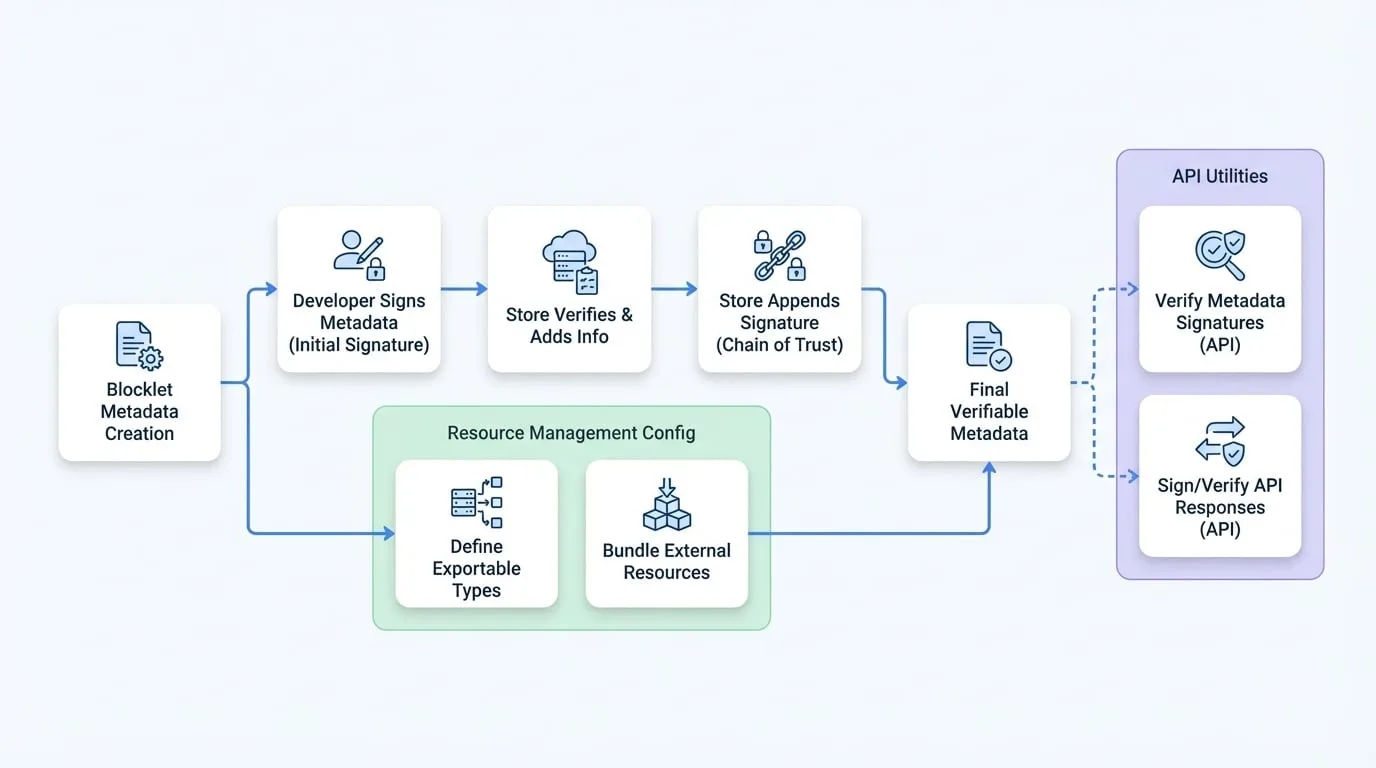
The signatures field contains an array of digital signatures that create a verifiable chain of trust for the Blocklet's metadata. This mechanism prevents unauthorized modifications and confirms the identity of the publishers, such as the developer and the Blocklet Store. Each signature in the chain cryptographically signs the core metadata along with any subsequent signatures, ensuring that the entire history of modifications is tamper-proof.
Multi-Signature Process Flow
The typical multi-signature workflow during the publishing process involves the developer signing the initial metadata, followed by the Blocklet Store verifying it, adding distribution information, and appending its own signature.
Specification
The signatures field is an array of signature objects. Each object has the following structure:
blocklet.yml
signatures:
  - type: 'ED25519'
    name: 'dev'
    signer: 'z8qa...'
    pk: 'z28n...'
    created: '2023-10-27T10:00:00.000Z'
    sig: 'z24e...'
    excludes: []
  - type: 'ED25519'
    name: 'store'
    signer: 'z8qR...'
    pk: 'z29c...'
    created: '2023-10-27T10:05:00.000Z'
    sig: 'z25a...'
    appended:
      - 'dist'
- 'stats'- type
string(required) — The cryptographic algorithm used for the signature (e.g., 'ED25519'). - name
string(required) — A human-readable name for the signature's role (e.g., 'dev', 'store'). - signer
string(required) — The DID of the entity that created the signature. - pk
string(required) — The public key corresponding to the signer's DID. - created
string(required) — The ISO 8601 timestamp when the signature was created. - sig
string(required) — The base58-encoded signature string. - excludes
string[]— An array of top-level field names to exclude from the metadata before signing. - appended
string[]— An array of top-level field names that were added to the metadata by this signer. This is used by the next signer to correctly verify the previous signature. - delegatee
string— The DID of the delegatee if the signature was made through delegation. - delegateePk
string— The public key of the delegatee. - delegation
string— The delegation token (JWT) authorizing thedelegateeto sign on behalf of thesigner.
Resource Management
The resource field allows a Blocklet to declare shared data types it can export and to bundle resources from other Blocklets. This is fundamental to enabling a composable and interoperable ecosystem where Blocklets can share data and functionality seamlessly.
Specification
blocklet.yml
resource:
  exportApi: '/api/resources'
  types:
    - type: 'posts'
      description: 'A collection of blog posts.'
    - type: 'images'
      description: 'A gallery of images.'
  bundles:
    - did: 'z2qa...'
      type: 'user-profiles'
public: true- resource
object— Contains properties for defining exportable types and bundled resources.- exportApi
string— A path to an API endpoint that other Blocklets can call to fetch exported resources. - types
object[]— An array of resource types that this Blocklet can export. Limited to a maximum of 10 types.- type
string(required) — The unique identifier for the resource type (e.g., 'posts', 'products'). - description
string— A human-readable description of the resource type.
- type
- bundles
object[]— An array of resource bundles imported from other Blocklets.- did
string(required) — The DID of the resource bundle to include. - type
string(required) — The specific resource type to bundle from the source. - public
boolean— Iftrue, indicates that the bundled resource is publicly accessible.
- did
- exportApi
Related API Utilities
The @blocklet/meta library provides a suite of functions to handle the security aspects of a Blocklet's metadata and communications. For full details, see the Security Utilities API Reference.
Verifying Metadata Signatures
The verifyMultiSig function is the primary tool for ensuring the integrity of a blocklet.yml file. It processes the signatures array, verifying each signature in the chain to confirm that the metadata has not been tampered with and was signed by the declared entities.
verifyMultiSig Example
import verifyMultiSig from '@blocklet/meta/lib/verify-multi-sig';
import { TBlockletMeta } from '@blocklet/meta/lib/types';

async function checkMetadata(meta: TBlockletMeta) {
  const isValid = await verifyMultiSig(meta);
  if (isValid) {
    console.log('Blocklet metadata is authentic and untampered.');
  } else {
    console.error('WARNING: Blocklet metadata verification failed!');
  }
}
Signing and Verifying API Responses
For securing communications between Blocklets or between a Blocklet and a client, you can use the signResponse and verifyResponse functions. These helpers use a wallet object to cryptographically sign and verify any JSON-serializable data, ensuring data integrity and sender authenticity.
signResponse Example
import { signResponse, verifyResponse } from '@blocklet/meta/lib/security';
import { fromRandom } from '@ocap/wallet';

async function secureCommunicate() {
  const wallet = fromRandom(); // Your Blocklet's wallet
  const data = { message: 'hello world', timestamp: Date.now() };

  // Signing
  const signedData = signResponse(data, wallet);
  console.log('Signed Data:', signedData);

  // Verifying
  const isVerified = await verifyResponse(signedData, wallet);
  console.log('Verification result:', isVerified); // true
}