Blockchain upgrade: Gas-free staking now easier than ever!
We're thrilled to announce an update to our blockchain that marks a tiny milestone in our journey towards simplifying and enhancing user experience. This latest upgrade is a testament to our commitment to innovation and user-centric development.
Previously, the process to enable gas-free transactions for your DID Wallet involved a slightly complex mechanism. Users needed to get more than 1 ABT: 1 ABT for staking and an additional 0.0002 ABT to cover the transaction gas fee. This extra step, albeit small, was an inconvenience that we recognized and have effectively addressed in our latest update.
With this upgrade, we have made a subtle yet impactful change: the elimination of the gas fee for stake-for-gas transactions. Now, to enable gas-free transactions from your DID Wallet, all that's required is a 1 ABT stake. This means that with just 1 ABT, any account can successfully send staking transactions, unlocking the full potential of gas-free operations for all subsequent transactions.
Here is a comparison of staking transactions before and after the upgrade
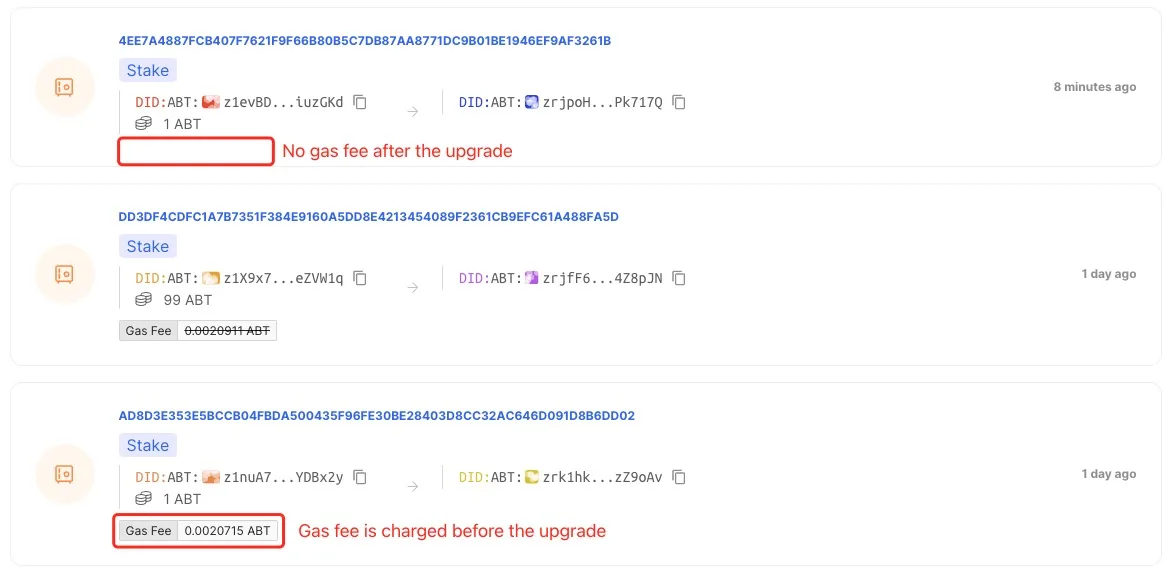
This enhancement not only simplifies the process but also makes it more accessible for users. If you're helping a friend set up their DID Wallet, the process just got easier. Simply send them 1 ABT, initiate a staking transaction from their wallet, and voilà! Their wallet is now enabled for gas-free transactions.
We are excited to roll out this update, as it significantly lowers the barrier for users to enjoy the benefits of our blockchain technology. For more details on staking and gas fees on ArcBlock Chain please check out:
Referenced here
Products
-
ArcBlock Chain
active
The application-focused Layer 1 for identity, assets and agreements. ArcBlock Chain brings these operations into the protocol, with ABT as the public network’s native token.
Terms
-
Blockchain
A distributed ledger that links records cryptographically and uses shared validation and consensus rules to establish an accepted transaction history.
-
Staking
Locking an amount as a bond behind work a participant performs, so that breaking the rule they agreed to has a cost that the protocol can act on. The bond is what makes the promise checkable rather than merely stated.